This is default featured slide 1 title

Go to Blogger edit html and find these sentences.Now replace these sentences with your own descriptions.

This is default featured slide 2 title

Go to Blogger edit html and find these sentences.Now replace these sentences with your own descriptions.

This is default featured slide 3 title

Go to Blogger edit html and find these sentences.Now replace these sentences with your own descriptions.

This is default featured slide 4 title

Go to Blogger edit html and find these sentences.Now replace these sentences with your own descriptions.

This is default featured slide 5 title

Go to Blogger edit html and find these sentences.Now replace these sentences with your own descriptions.

Showing posts with label Kia. Show all posts

Kia Ceed 2013

Making its global premiere at the 2012 Geneva International Motor Show is the all-new Kia cee'd. More sophisticated, more efficient, more refined and with a more engaging driving experience than its predecessor, new cee'd is expected to build on the success of the original model, further establishing Kia as one of the leading automotive brands in Europe.
 Launched in 2007, the original cee'd was a landmark and game-changing model for Kia. Designed, developed and built in Europe, cee'd was the first model to establish Kia as a serious contender to the established brands. Winning praise from media and public alike for its all-round ownership proposition, cee'd claimed fourth place in the European Car of the Year Awards that year - the highest ever ranking for a Kia vehicle.
"The original cee'd was a paradigm shift for Kia, taking the company into the hotly contested C-segment with a truly competitive car for the first time," comments Paul Philpott, Chief Operating Officer, Kia Motors Europe. "Just as the original cee'd represented a major step forward for Kia in 2007, this second-generation model represents a further leap for the brand - both in terms of the capability and sophistication of the vehicle, and what it will do to drive further momentum in our European sales.
"Since launch, the cee'd family has recorded over 430,000 sales in Western Europe, changing the public perception of our brand and laying the foundations for a series of new Kia models across a broad spread of market sectors.

Longer, lower and more streamlined
New cee'd is both longer and lower than its predecessor, giving the five-door hatchback a more sporty profile. Overall length is increased by 50 mm (to 4,310 mm) and overall height has been reduced by 10 mm (to 1,470 mm) by lowering the ride height. Despite being based on a completely new platform, new cee'd carries over the 2,650 mm wheelbase, one of the longest in the C-segment, from its predecessor.
 This more athletic appearance is further enhanced by a wider track. While the overall bodyshell is 10 mm narrower, the front and rear track have been increased (by 17 mm and 32 mm, respectively). The impact on the car's aesthetics is heightened by the availability of 17- and 18-inch diameter alloy wheels, resulting in a minimal gap between tyres and bodywork.
The new model's sleek silhouette was shaped by extensive testing in the state-of-the-art wind tunnel at Kia's R&D centre at Namyang, Korea. A reduced windscreen angle, smooth covers beneath the engine bay and the central floor, a rear spoiler above the tailgate and carefully profiled rear lamp clusters all help new cee'd achieve a Cd figure of just 0.30, placing it among the best-in-class, and helping to reduce fuel consumption and cabin noise.
New Kia cee'd will be manufactured exclusively at Kia's Zilina facility in Slovakia in a range of 10 exterior colours - including five new - and will be among the first models to bear the new-look Kia badge on its bonnet. Simpler, sleeker and with a more modern appearance, the new badge design echoes the premium feel of new cee'd and incorporates the Kia script in a single raised section for greater legibility.
Powerful and efficient engines with six-speed transmissions
In developing new cee'd, Kia's engineers had a strong focus on reducing fuel consumption and emissions without sacrificing engine response or power output. Updated engines and various small but impactful changes have resulted in an average fuel consumption improvement of four per cent across the model range.
 Depending on individual market preferences, the new cee'd will be available with a wide choice of engines offering power outputs from 90 to 135 ps. Across most of Western Europe there will be two petrol engines - a 1.4 MPI and a 1.6 GDI producing 100 and 135 ps respectively - plus two diesels - a 1.4 WGT with an output of 90 ps and 1.6 VGT diesel offered in two states of tune (110 and 128 ps). Certain markets in Europe will also offer a 1.6 MPI petrol unit producing 130 ps.
Kia anticipates that its top of the range diesel - the highly-efficient 1.6-litre variable geometry turbo unit - will be the most popular choice in most markets. Generating 128 ps and 260 Nm, the engine will be offered with a choice of six-speed manual or automatic transmissions and will accelerate the new cee'd to 100 kph in less than 11 seconds. Fuel consumption will be just 4.1 l/100 km on the combined cycle (3.7 l/100 km in cars fitted with Kia's EcoDynamics technologies), and CO2 emissions start at just 97 g/km.
The 'Gamma' petrol engines also offer an excellent balance between performance and economy. The most powerful, the 1.6-litre Gamma GDI engine introduced in the Kia Sportage, features direct injection to maximise power (135 ps) and torque (165 Nm) while minimising fuel consumption and emissions. With this engine, new cee'd will accelerate to 100 kph in 9.9 seconds while delivering fuel consumption of 5.8 l/100 km (5.2 l/100 km with EcoDynamics), and tailpipe CO2 emissions from 119 g/km.
All engines will be offered with a choice of manual or automatic six-speed transmissions. Depending on version, the 1.6 GDI will also be available with Kia's all-new six-speed Dual Clutch Transmission (DCT), which improves fuel efficiency and delivers smooth automatic gear shifts for maximum comfort.
 Developed by Kia's in-house transmission development team in partnership with a German-based engineering firm, the DCT makes the Korean brand one of a very small number of car makers in the world to produce its own dual-clutch transmission.
The DCT combines two manual transmissions within a single housing, each with its own dry clutch. One transmission shaft is dedicated to 2nd, 4th, 6th and reverse gear, while the other operates with 1st, 3rd and 5th gears.
Working in parallel, one shaft prepares to engage the next ratio, while the other is still engaged with a gear. Electric motor-driven actuators controlled by the Transmission Control Unit (TCU) execute gear selection and clutch engagement, resulting in swift and precise gear changes and uninterrupted torque transfer to the driven wheels, with a minimum of the efficiency loss normally associated with conventional automatics (with a torque converter).
As with other Kia models in Europe, new cee'd will be available with fuel-saving technologies developed under the company's EcoDynamics™ sub-brand to optimise efficiency and lower emissions. These technologies, which will be available on both diesel and petrol models with manual transmission, include ISG (Start/Stop), low-rolling resistance tyres and an alternator management system (AMS).
Smoother ride with improved handling, plus variable power steering
Ride and handling for new cee'd was benchmarked against class-leading competitor vehicles from near-premium brands.
Fully-independent, subframe-mounted suspension with MacPherson struts at the front and a multi-link set-up at the rear exploit the newcomer's wider track to deliver improved handling and road-holding.
The hugely increased torsional rigidity of the new cee'd bodyshell (45 per cent stiffer than the original model), has also enabled Kia's engineers to introduce numerous small changes to components, springs and shock absorbers that influence ride quality, refinement and NVH.
 Improvements to the front suspension include an increased castor angle (from 4.4 to 5.2 degrees) for greater straight-line stability, larger wheel bearings in a reinforced hub, and larger diameter bushes for the subframe attachments. At the rear, geometry changes ensure more accurate tracking, the trailing arms have larger bushes and friction has been reduced throughout the system.
The standard steering system employs electric power-assistance and requires 2.85 turns lock-to-lock for a 10.34-metre turning circle. New cee'd is also available, on certain models, with an all-new Flex Steer™ system for improved driving dynamics. This system introduces three operating modes - comfort, normal and sport - allowing the driver to vary the level of steering assistance and the weight of feedback, in order to best suit the current driving conditions and the driver's personal preferences.
Less cabin noise, more cabin space
Kia's engineering team was determined to achieve significant improvements over the previous model in terms of cabin refinement and NVH. Measures adopted include fitting 14 per cent thicker front door window glass, low-drag exterior mirror housings, new vibration-damping engine mounts, hollow drive shafts, stronger bodyshell joints between the sills and B-pillars, double-layer door seals, and increased foam-filling in the A-, B- and C-pillars. As a result of these measures, cabin noise levels have been cut to match class-best standards.
Although the 2,650 mm wheelbase is carried over for new cee'd, the increase in overall length contributes to more interior space for people and cargo. Front seat occupants have 12 mm more headroom and 21 mm more legroom, while rear passengers gain 5 mm of shoulder room. Cargo capacity is boosted by 12 per cent to 380 litres (up 40 litres) with the rear seats upright and the split-folding rear seats can be made fully flat for maximum versatility.
High-quality equipment and advanced technologies
Higher quality cabin materials and a broader range of high-tech equipment will ensure the interior of new cee'd matches the premium exterior appearance.
Primary and secondary controls are grouped in a driver-oriented layout for intuitive ease of use, while new standard equipment will include tilt and telescopic steering wheel adjustment, iPod, Aux and USB support, six speaker audio system and a multi-mode trip computer.
A choice of bright chrome, piano black and anodized metal trim accents will be offered, while indirect LED lighting of the centre console and sweeping 'vertical fin' door handles establish an upmarket ambience for the cabin. The seat and cabin trim will be available in a choice of two colours as standard - black one-tone and stone beige two-tone - in cloth, with a full leather interior available on high specification versions.
Available features will include enhanced instrumentation - with a TFT 'Supervision' Cluster delivering high-definition resolution clarity of the instrument binnacle, dual-zone climate control, powered driver's seat adjustment with memory and a full length (1,045 mm long) powered panoramic glass sunroof.
New Kia cee'd will be available, depending on version, with LED daytime running lights, fixed cornering lamps (illuminated depending on steering angle), and advanced HID headlamps that turn the low beam to match curves in the road and enhance the driver's night vision.
Parking can be made easier with the new Parallel Park Assist System (PPAS). This features front, side and rear sensors and automatic steering control by an on-board computer to safely perform parallel parking. The driver remains in control of the accelerator and brake.
Safety structure and features target maximum rating
Kia continues to make safety a top priority and the new cee'd features advanced active and passive safety technologies to ensure maximum protection for its occupants and other road users. Kia is determined to achieve the maximum rating when tested by EuroNCAP with this new model.
Available active safety features will include ESP (Electronic Stability Program), ABS (anti-lock braking system), BAS (emergency Brake Assist System), HAC (Hill Assist Control) to prevent roll-back, VSM (Vehicle Stability Management) and ESS (Emergency Stop Signal) which flashes the brake lights when the system detects that the driver is making an emergency stop.
In terms of passive safety, the bodyshell is constructed using a high percentage (57 per cent) of ultra high-tensile steel and features numerous improvements to enhance impact resistance. New transverse cross-members are fitted to link the front and rear suspension mounts, new pressings link the rear trunk floor to the tailgate opening and the rear roof rail is connected to the C-pillars and a new floor cross-member to create an extremely strong 'safety ring'.
Side impact protection is enhanced with 50 per cent thicker door beams, plus a stronger roof cross-member between the B-pillars and side sills made from ultra high-tensile steel.
Each new cee'd is fitted with six airbags as standard - front, front side and full length curtain. Pedestrian safety is improved with the adoption of collapsible headlamps, a stiffer lower bumper lip, and shock-absorbing structures in the hood and its hinges.

Kia Ray EV

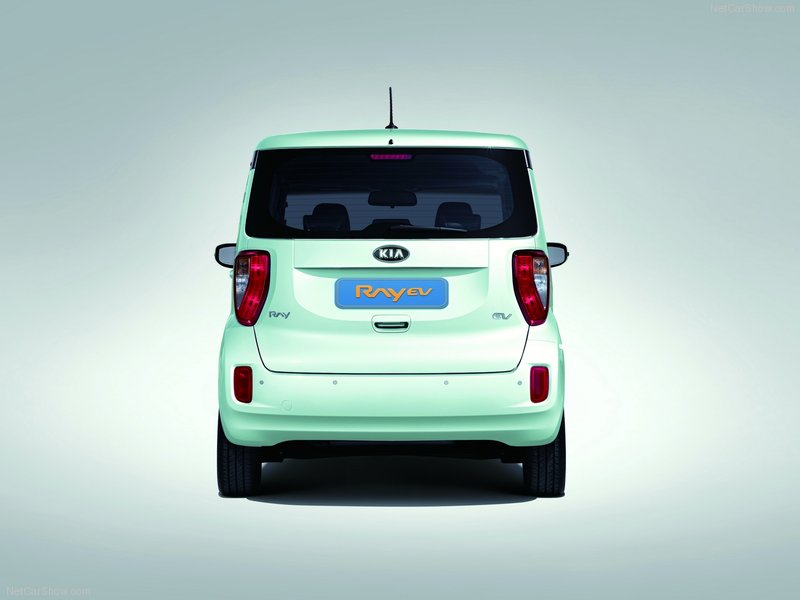
Kia Motors introduced Korea's first electric vehicle, with the launch of the new Kia Ray EV - a zero-emissions city car with lively performance and a range of up to 139 km (86 miles) on a single charge.
For supply exclusively to the domestic Korean market, the Kia Ray EV is a close relative of Kia's 1.0-liter gasoline powered Ray CUV. It shares that model's major dimensions and, in a global first for an EV manufacturer, can share a production line with conventional combustion-engine cars.
The front-wheel drive Kia Ray EV is powered by a 50kW electric motor and a high-capacity 16.4 kWh lithium ion polymer battery pack that is engineered for a 10-year life cycle and skillfully packaged under the rear seat and cabin floor.
Although the Kia Ray EV weighs 187 kg more than the gasoline model, the electric motor's generous torque - 167 Nm (an increase of 77%) - ensures responsive performance. The EV's acceleration is brisker than the gasoline models (0-to-100 kph in 15.9 seconds), while top speed is 130 kph (81 mph). Recharging times are six hours using a 220V household supply and just 25 minutes in fast-charge mode.
 The Kia Ray EV's automatic transmission offers the driver a choice of two modes while in 'D' drive. 'E' (or 'eco') mode optimizes the delivery of the motor's torque to achieve minimum battery consumption and maximum driving range. 'B' (or 'brake') mode can be selected when driving downhill on highways and on mountain roads to maximize braking power.
Bearing the same striking exterior styling as its gasoline cousin, the Kia Ray EV has four small distinguishing points. A flap in the front radiator grille covers an electricity inlet for a 220V supply for the slow recharge mode, another inlet (for the fast recharge mode) is fitted in the same location as the fuel intake of the regular models, special decals on each front door proclaim the 'Zero Emissions EV' message and super-smooth 14-inch alloy wheels improve aerodynamic performance by minimizing drag.
Inside, the Kia Ray EV features a unique instrument cluster, displaying electric motor operation, battery status and distance to recharge. It is also equipped with the first-ever EV-specific navigation system that features a 7-inch screen and provides crucial information for EV drivers such as the nearest locations of the slow/fast recharging stations. The display shows a circular shaped area in which the model can travel with its current level of battery power, so that drivers can see which destinations are reachable without a recharge.
 Currently there are 500 slow/fast recharge stations in Korea, and the government plans to increase that figure to 3,100 stations by the end of 2012.
The Kia Ray EV embodies numerous innovations. The electric motor achieves 93% efficiency, which is the best in its segment. The lithium ion polymer battery's cell is optimized and highly integrated, which has enabled its weight to be reduced by 13% and its energy density to be increased by 15% compared to competitors' systems.
The on-board charger, current inverter, high-low voltage converter and EV-specific VCU (vehicle control unit) each features advances over previous equipment.
Kia Ray EV is also equipped with a new type of regenerative braking system featuring an Active Hydraulic Booster that utilizes the electric motor, instead of the gasoline engine in the regular model, to create hydraulic pressure for the brake system. The result is consistent brake pedal force throughout a wide variety of driving conditions and the ability to harvest excess energy and use it to recharge the car's battery.
 Unlike regular gasoline vehicles, Kia Ray EV generates no engine noise, which can be a potential problem with pedestrians being unaware of the approaching car. To prevent accidents, Kia has fitted Ray EV with a VESS (Virtual Engine Sound System). When driven at speeds below 20 kph (12 mph) this system delivers a mixture of recorded gasoline engine noises, which are also emitted whenever the car is backing up.
Japan and the USA are already considering the introduction of a legal requirement for EVs to have a virtual engine sound, and Kia has taken the first step to commercialize this system in order to anticipate the global industry's trend.
To ensure that the Kia Ray EV is as safe as gasoline cars, it is equipped with six air-bags, and electronic stability features - VDC (Vehicle Dynamics Control) and HAC (Hill Assist Control, to prevent roll-back) - as standard.
 During 2012, Kia is planning to manufacture 2,500 units of the Kia Ray EV, which will be provided to government departments and public offices as part of Kia's long-term real-world research and development program to provide environmentally friendly transport to Kia customers around the world during the next decade.

Technical Specification
  • DIMENSIONS
    • Length: 3593 mm
    • Width: 1595 mm
    • Height: 1700 mm
    • Wheelbase: 2520 mm
    • Kerb weight: 1185 kg
  • POWERTRAIN
    • Type: Electric motor
    • Max power: 68 PS (50 kW)
    • Max torque: 167 Nm (17.0 g/km)
  • BATTERY
    • Power: 330V Lithium ion polymer
    • Capacity : 16.4 kWh
    • Charge time: 6.0 hrs (slow) / 25 minutes (fast)
  • PERFORMANCE
    • 0-100 km/h (62 mph): 15.9 s
    • Top speed: 130 km/h (81 mph)
    • Max range: 139 km (86 miles)

Kia Sportage SX

With a new bodyshell, new engines and fresh, bold styling that introduces a new kind of dynamic aesthetics, the latest Kia Sportage is an urban-friendly compact SUV for today's families - consuming less fuel and emitting less CO2.
Longer, wider and lower than the previous model - by 90 mm, 15 mm and 60 mm respectively - the all-new design successfully retains the key SUV features - a commanding driving position, heightened sense of security and powerful road presence - that made the second-generation Kia Sportage so popular.
The second-generation Kia Sportage was introduced in 2004 and marked a huge step forward for Kia. Over the next six years, it attracted thousands of new customers to Kia, and achieved global sales of more than 860,000 units - including 150,000 units in Western Europe.
 Now, under the direction of Kia's Chief Design Officer Peter Schreyer, the Kia design teams have created a third-generation Sportage incorporating Kia's new design DNA and many features from the 2007 Kia Kue concept car, to be immediately identifiable and to stand out from potential rivals in an increasingly crowded segment.
"With the all-new Kia Sportage, we have created a five-seat compact SUV with maximized customer appeal. It is urban-friendly and fully in tune with changing consumer expectations and demands," commented Hyoung-Keun Lee, President, Kia Motors Corporation.
"Despite the recent and ongoing global economic difficulties, Kia's market research indicates that demand for C-segment SUVs in Europe will grow steadily over the next five years as customers down-size their vehicles and new models focus attention on the segment.
 "Customer response to the new Kia Sportage in Europe has been entirely positive and we are confident that our latest model will significantly increase Kia's share of the compact SUV market," concludes President Lee.
New Sportage has an aerodynamic drag figure of Cd 0.37 - down from 0.40 - and a reduction in weight of 91 kg compared with the previous model enhancing fuel economy and refinement.
Choice of engines with enhanced economy and lowered emissions
When the full range of new Kia Sportage models is on sale later this year, it will be available with four engines - two petrol and two diesel, ranging between 115 ps to 163 ps - manual and automatic transmissions and two-wheel or four-wheel drive. The model range presented to customers will vary country-by-country across Europe to suit local requirements and preferences. Final decisions on the UK range are yet to be made but all the engine variants will be available and Kia Motors (UK) Ltd., plans to take all the transmission and drive options.
 For new Kia Sportage the 2-litre diesel and petrol engines available at launch will be joined by smaller capacity engines available with fuel-stretching ISG (Intelligent Stop & Go) technology and with CO2 emissions from as low as 138 g/km.
Enhancing occupant and pedestrian safety
Fitted as standard in most European countries, new safety features will include ESC with a new Roll-over Sensor that deploys the side airbags, curtain airbags and seatbelt pretensioners when required, Hillstart Assist Control to prevent roll-back when starting on an incline, Downhill Brake Control to limit speed during a steep descent and an ESS system which flashes the brake lights during an emergency.
A new rear-view safety camera providing on an LCD colour display integrated into the interior rear-view mirror will be available as an option on all models.
 Appealing to existing and new Kia Sportage customers
New Kia Sportage will be manufactured at Kia's factory at Zilina, in Slovakia and buyers will be offered a choice up to 10 exterior colours and a black interior, trimmed in cloth, part-leather or full-leather that can be personalised with dark, light or orange accents. The quality of the cabin has been greatly improved. Available high-tech features will include: Xenon HID headlamps, LED running lights, keyless entry, engine start button, reversing safety camera, built-in sat-nav and full-length panoramic glass sunroof.
Kia's latest compact SUV will benefit from the brand's unique 7-Year Kia Warranty in Europe. The all-new Sportage range will begin to appear in showrooms across Europe during the summer.
Introducing a new kind of dynamic aesthetics
 The new Kia Sportage marks a dramatic shift in design direction for Kia's compact SUV. Longer, lower and wider than the previous generation model, the new Kia Sportage is immediately identifiable by its 'tiger' face - incorporating Peter Schreyer's striking signature grille design that links all new Kia models.
"The new Sportage is fresh and bold and could not be mistaken for anything other than a Kia," said Peter Schreyer, Kia's Chief Design Officer. "It embodies Kia's new-found visual dynamism by successfully taking the key features of an off-road vehicle - the raised ground clearance, the commanding driving position and heightened sense of security - and enveloping them in a sleek and urban-friendly design with global appeal. With its athletic and muscular design the Kia Sportage fits its name perfectly."
 Sitting below the central bonnet-mounted badge, the 'tiger face' sweeps out to effectively frame the grille before broadening out and encompassing the car's large and piercing headlamps to create a distinctive and powerful face. The strength of this look is reinforced by the clamshell bonnet and its contours that run into raised shoulders as they flow down to meet the headlamps.
"The clamshell bonnet gives a sense of strength and solidity to the front end," said Schreyer. "Together with the grille, these shoulders create a strong three-dimensional feel to the face of the new Kia Sportage, and they also help the driver accurately place the car on the road."
The new Kia Sportage's athleticism is reinforced by its rakish windscreen angle, which sweeps seamlessly into the low roofline. And the top of the screen itself reflects the grille profile. "The profile line of the top of the windscreen mirrors that of the grille," explains Gregory Guillaume, Chief Designer, Kia Europe.
 "We first featured this element on the Kee concept car, at the 2007 Frankfurt Motor Show. This is followed through to the rear, which has the same distinctive outline at the base of the rear windscreen. These two features instantly heighten the Kia Sportage's on-the-road visibility - as do its sculpted flanks featuring a striking concave motif in the door panels and the flared wheel-arches."
The key design element of new Sportage's purposeful stance is the relationship between its high shoulders and narrow glasshouse, explained Schreyer. "We've created a vehicle with a sportscar-like ratio between sheet metal and glass. The side-windows are very narrow that gives an almost rally-car feeling. Follow the shoulder and roof lines and they meet at the striking reverse-angled C-pillar.
"The size, the shape and the proportion of the C-pillar on any car is absolutely crucial to its appearance, and as you can see on our new Kia Sportage, it determines the entire look and feel of the car," he added.
 Using a tape-measure against the new Kia Sportage confirms it is slightly lower than the previous generation, but the design makes it look significantly lower, and both sleeker and more assertive.
Mirroring the large headlamps up front, the rear of the new Kia Sportage features prominent taillights that flow across the tailgate and into the car's broad rear shoulders. Raising the rear spoiler-topped hatch reveals a large, deep and regular-shaped cargo bay.
Many of the new Kia Sportage's external design features - the rakish windscreen angle, the radically angled C-pillar and the signature sculpting of the car's flanks, were first hinted at in the Kue concept car, star of the 2007 Detroit Motor Show.
"It's crucial that we draw real design inspiration from our concept and showcars, like the Kue, and inject that motivation into our production cars. The new Kia Sportage is clear proof of that," commented Schreyer.
A raft of details - the ribbed roof, the chunky door handles, the roof-rails, the raised ride height and the large wing mirrors - serve to further reinforce the Kia's go-anywhere credentials. The new Sportage's spacious cabin looks as dynamic and sporting as its exterior. It's dominated by the sweeping dashboard, which broadens from the edges and then narrows dramatically in the middle to create an eye-catching centre console. This emphasises the width of the car, making those on board feel protected, safe and secure.
 Guillaume explained: "The horizontal layers break up the dashboard, so you are not facing a vast cliff of plastic, while the high centre tunnel bisects the front cabin. It's anything but the typical T-shaped dashboard/console layout you will find in most vehicles."
Those high shoulders and the narrow glasshouse hint at the new Kia Sportage's dynamic driving position, enhanced by the chunky small-diameter three-spoke steering wheel and deep-set cowled instruments.
"The exterior design is very sporty for a car of this type, and although you sit high in the cabin there's still something very sporting about it because the windscreen has a very fast angle and the shoulder line is very high," said Guillaume. "This gives you a cocooned and safe feeling, and yet from a practical point of view there is still plenty of rear headroom."
In the generously proportioned rear cabin, the boldly angled C-pillar cuts back on itself well behind the rear passengers, to enhance the car's low-slung profile without encroaching on their view out.
Peter Schreyer intends to transform the public perception of Kia all around the world. "I want to give Kia global appeal - I want that appeal to be about design above all else. The new Kia Sportage is a major step towards achieving that goal.
 Top-quality trim and equipment with high-tech features
Kia is confident that when current Kia Sportage owners and new customers to the brand visit dealer showrooms to view the all-new Kia Sportage, they will be mightily impressed by the newcomer. Its showroom 'presence' will be both impactful and surprising.
New Kia Sportage will be available in a stunning new metallic colour - Techno Orange - and first impressions will also be enhanced by the new bright chrome finish for the front grille- the strong Kia 'face' - as well as the bold reverse-angle C-pillar, the wider track, purposeful stance and much closer relationship between the wheels, tyres and wheel-arch - creating a premium appearance and echoing the precision and care that has been applied to the entire vehicle.
Inside new Kia Sportage, the styling echoes the new kind of dynamic aesthetics created by the exterior appearance and establishes a new kind of ambience, with top-quality fit, discreet trim accents and the availability of numerous high-tech features. New Sportage will be built with a choice of two equipment levels, LX and EX (for details see Section 8), plus a wide range of options.
 The longer bodyshell and longer wheelbase, plus the extra interior width ensure that occupants of the new Kia Sportage will enjoy its spacious cabin. The adoption of a reverse-angle for the C-pillar moves it 186 mm further back - compared with the previous model - placing it behind the rear seat passengers to provide them with a clear view out. Entry and exit from the cabin is made easier by lowering the seats by 29 mm and the top of the door sills by 31 mm.
Driver comfort is enhanced by the adoption of a floor-hinged accelerator pedal that allows smooth control of the throttle and by the increased range of fore and aft sliding movement available for the driver's seat - 24 mm more than the previous model. As an option, heated front and rear seats can be specified.
The thick-rimmed four-spoke steering wheel and the 'three-cylinder' instrument cluster are becoming Kia trademark features. Similar to the cluster fitted to the Soul, Sorento and Venga, the new Kia Sportage's instruments have clear and precise graphics. A 'Super Vision' cluster with red lighting will be available as an option.
New Kia Sportage's interior comes trimmed in black cloth as standard - and unusually, an all-black headliner can be specified. Options include part-leather and full-leather seat trim, with a choice of contrasting stitching. LX models feature a Dark Gunmetal dashboard and centre stack, while colour options include Medium Grey, Light Alpine and Orange door inserts, plus Alpine Metallic centre stack trim.
 Manual air-conditioning is standard. The audio system for new Sportage features an RDS radio and CD player with MP3, USB and iPod connectivity - with door-mounted speakers and a tweeter at each end of the dashboard. An all-new audio visual navigation system with a 7.0-inch screen, Bluetooth and voice recognition will be offered.
Other available high-tech 'comfort & convenience' features include a Smart Card for keyless entry, together with an engine start/stop button, 'welcome home' escort lights, Xenon headlamps, LED Daytime Running Lights and a tailgate-mounted reversing safety camera with interior mirror display monitor.
A total of 10 exterior colours available will be: solid colours x 2: Cassa White and Clyde Blue and metallic colours x 8: Dark Gunmetal, Techno Orange, Sand Track, Black Pearl, Pheonix Silver, Sirius Silver, Machine Silver, and Byte Blue.
 More space for people and cargo, and a quieter drive
Luggage space in new Kia Sportage benefits from the 70 mm increase in the vehicle's rear overhang. With the rear seats upright, the cargo bay is 80 mm longer and 110 mm wider at floor level, thanks to the more compact design of the rear suspension. Cargo capacity is among the best in class and ranges from 564 litres with the rear seats occupied to 1353 litres with the rear seats folded down.
Storage space within the cabin includes the larger glovebox - cooled in some models, a larger 6.0-litre centre console - up from 3.0-litres, and four door pockets. Two large cup-holders are located between the gear selector and the centre console, while the folding centre armrest in the rear seat has twin cup-holders.
New Kia Sportage is significantly quieter and more refined than its predecessor. The all-new bodyshell design and greater use of high tensile steel have resulted in a stiffer and safer vehicle in which occupants will be aware of fewer vibrations from the road surface or mechanical components.
 New diesel and petrol engines to power new Sportage
Manufactured at Kia's world-class facility in Slovakia, the all-new Kia Sportage will ultimately be available in Europe with a wide choice of engines. At launch this summer, the engine line-up will comprise 2-litre diesel and 2-litre petrol engines - with a 1.7-litre diesel and a 1.6-litre GDI petrol unit to follow later this year, reducing the new model's base-line CO2 emissions to less than 140 g/km.
Diesels demonstrate Kia's world-class engineering
At the 2010 Geneva Show and making its premiere in the new Sportage, is a 2.0-litre version of Kia's next-generation 'R' family diesel. All-new, the 'R' family diesel engine first appeared in 2.2-litre, 197 ps form, in the new Kia Sorento confirming that Kia's engineering capabilities are indeed world-class.
The R2.0, which is expected to prove the most popular engine choice with new Kia Sportage buyers in many European countries, generates a maximum of 136 ps and 304 Nm of torque from just 1,800 rpm. As well as guaranteeing strong performance, the new diesel enables the Kia's compact SUV to deliver highly-competitive fuel economy and emissions figures.
 Later this year, a new 1.7-litre version of Kia's 'U2' diesel will become available. Designed and engineered at Kia's R&D Centre in Germany, this 115 ps engine meets Euro 5 emissions regulations and is cleaner, quieter and more fuel-efficient than previous U2 engines. It has been developed for optimum driveability, with more than 90 per cent of the maximum torque available from just 2,000 rpm.
Petrol engines blend power with economy
Now fitted with upgraded electronics and low-friction components, Kia's revised 2.0-litre 'Theta II' petrol engine delivers more power, improved durability, enhanced refinement and reduced fuel consumption and emissions.
This four-cylinder 1998 cc powerunit has dual CVVT (continuously variable valve timing) for both the intake and exhaust valves, four valves per cylinder and features weight-saving, all-aluminium construction with a cast aluminium block, cylinder head and sump. Fitted in new Sportage, maximum power is 163 ps, with 194 Nm of peak torque at a modest 4600 rpm.
Later this year, new Kia Sportage buyers whose priority is fuel-economy, will be able to order Kia's 1.6-litre Gamma petrol engine fitted with GDI (petrol direct injection) technology. Producing a highly competitive 140 ps, the arrival of this engine marks the first appearance of GDI technology in a Kia vehicle.
GDI lowers emissions while raising power and torque outputs and improving fuel economy. The typical range of benefits include delivering 7% more torque at low revolutions, 12% more torque at high revs and 10% better fuel economy overall - compared to a conventional engine of a similar capacity.
Stop and Go available for two engines
By the end of 2010, Kia will be offering its fuel-stretching ISG (Intelligent Stop and Go) system as an option on both the 1.7 diesel and 1.6 GDI engine. ISG automatically switches the engine off whenever the vehicle is stopped in congested city driving and instantly restarts the engine when the driver selects first gear. Combined with other technologies in new Kia Sportage, ISG helps to reduce fuel consumption and tailpipe emissions.
 Several innovative fuel-saving technologies are fitted to the new Sportage as standard, including a gear-shift up/down indicator on all manual models, an ECO indicator to encourage economical driving on all automatic models and a power-saving alternator management system.
Choice of 2WD and AWD systems, plus three gearboxes
Buyers of the all-new Kia Sportage in Europe will be offered a choice 2WD or AWD drivetrains, and five-speed or six-speed manual and a six-speed automatic transmission.
For diesel Kia Sportage models, the standard gearbox is a six-speed manual, upgraded with improved synchronization, reduced power loss, enhanced efficiency and durability. Both the larger petrol and diesel engines can be specified with the optional six-speed automatic.
 Ultra-compact six-speed automatic transmission
Developed by the Hyundai-Kia Group for fitment in a wide range of future vehicles, the all-new six-speed automatic transmission now available for the new Kia Sportage is ultra-compact - and can feature a new optional 'paddle shift' system which allows drivers to change gear without taking their hands off the steering wheel.
The driver can choose from two operating modes - fully automatic or 'Sport'. For city driving, fully automatic mode is ideal, while 'Sport' mode allows for clutch-less manual gear changes for greater driver involvement - either using the selector lever or the new steering wheel-mounted paddles.
Whenever the car is stopped for more than a few seconds, the new transmission's innovative 'Neutral Control' function automatically shifts the transmission from 'D' to 'N', improving fuel economy especially in city driving.
Customer choice of advanced drivetrains with 2WD and AWD
Depending on individual markets, consumers ordering a new Kia Sportage will be able to select from five models with 2WD and four with AWD - employing advanced drivetrain systems similar to those introduced with the new Sorento in 2009.
On every Sportage model, traction is also boosted by the available Hillstart Assist Control that prevents the vehicle rolling backwards, and Downhill Brake Control that limits vehicle speed to just 8 km/h (5 mph) on steep descents.
For customers who drive on-road most of the time, the new Kia Sportage with the 2WD drivetrain offers lower weight, faster acceleration, enhanced fuel economy and good traction, aided by the standard-fit Traction Control System.
 For new Kia Sportage buyers who regularly face difficult driving conditions, go off-road or tow trailers, the AWD drivetrain will be ideal. It will be available with both the 2-litre petrol and diesel engines and manual or automatic transmissions as appropriate.
This AWD drivetrain is a single ratio (High) system, which delivers 100% of engine torque to the front wheels when driving in normal conditions, enhancing fuel efficiency. Whenever a front wheel loses grip a percentage of torque is automatically transferred to the rear wheels to maintain forward momentum.
When driving a new Kia Sportage with AWD in slippery conditions - such as rain, snow, mud, unpaved roads and off-road - the driver can manually select 'Lock Mode' for better stability. This mode shares the torque equally, between the front and rear axles and maintains that split up to a speed of 40 km/h (25 mph).
Achieving maximum protection through 'passive' technology
The new Kia Sportage has been designed to score a 5-Star rating in Euro NCAP's crash tests and maximum scores in the USA's two crash test programmes. The all-new platform and bodyshell employs a much greater proportion high strength and extra-high strength steels than the previous model.
Structural improvements include stronger and straighter longitudinal side members in the engine bay floor; an enhanced B-Pillar design that links to upper and lower cross-members to form an internal rollover hoop; reinforced floor members in the trunk floor and a rerouted and better protected fuel filler pipe.
In most European countries, new Sportage will be fitted with six airbags as standard. Dual front airbags, dual front side airbags and full-length side curtain airbags (linked to the new rollover sensors in the ESC system as well as the impact sensors) offer head protection for all occupants.
Active head restraints for the front seats of all models are standard in most European countries and protect occupants against whiplash injuries.

Kia Rio Sedan

Kia Motors America (KMA) celebrates the world premiers of the all-new 2012 Kia Rio sub-compact sedan and the comprehensively upgraded 2012 Kia Soul at the 2011 New York International Auto Show.
Scheduled to join the KMA line-up in the fall of 2011 - along with its 5-door hatchback sibling unveiled at the Geneva Motor Show in March 2011 - the all-new Kia Rio sedan ushers in the next chapter of Kia Motors' ongoing design-led transformation with eye-catching design, advanced technologies and sophistication in the small car segment. With all-new ISG (stop-start) technology and class-leading horsepower and fuel economy up to 40 miles per gallon (5.8L/100km), Rio promises consumers impressive fuel efficiency without sacrificing power or fun-to-drive performance.
 "The all-new Rio brings Kia's successful combination of world-class styling, outstanding fuel economy, advanced technologies and tremendous value to the smallest and most economical vehicle in the Kia line-up," said Michael Sprague, vice-president, marketing & communications, KMA. "With gas prices rising, sub-compacts are becoming increasingly popular and with more power, up to 40 miles per gallon fuel economy and stunning design, the all-new Rio sets the standard in the sub-compact class and becomes a vehicle that is not only affordable, but one that people will aspire to own."
Class-Leading Fuel-Efficiency and Horsepower
Available in the USA with a choice of three trims - LX, EX and SX - the 2012 Kia Rio is powered by a 1.6-litre GDI four-cylinder engine with the option of either a six-speed manual transmission or six-speed automatic. One of only two vehicles in this segment to offer a GDI (Gasoline Direct Injection) engine, the 2012 Rio offers consumers that elusive combination of power and impressive fuel efficiency, achieving class-leading 135HP (100kW) power and 
class-leading fuel economy rating of 30/40 mpg city/highway (7.8-5.8L/100km). Kia Rio also offers ISG technology, new to the Kia line-up, where the engine turns off when the vehicle is not in motion. The engine restarts automatically when the driver releases the brake pedal, resulting in lower levels of fuel consumption in stop-start urban traffic.
 Sleek and Streamlined Exterior
Conceived at Kia's design studios in Irvine, California, the all-new Rio sub-compact sedan and hatchback exhibit highly sculpted sloping shoulder lines and wedge-shaped exteriors, projecting an athletic profile that conveys power and agility. It also echoes the aggressive lines found on other recently launched Kia vehicles such as the 2011 Optima and Sportage. Both Kia Rio models sport their own interpretations of Kia's signature grille, slimmed down to connect to the dynamic headlamp design, providing a new twist on the Kia family look that includes a bigger air intake to exude a youthful persona.
Luxuriously Equipped Interior
 Inside, the 2012 Kia Rio envelopes driver and passengers in a bold and modern cabin, centred on Kia's characteristic horizontal three-cylinder instrument cluster and finished in two-tone trim to emphasize a feeling of spaciousness and comfort. The extended wheelbase (2570mm) greatly enhances passenger and cargo capacity for additional comfort.
In addition to offering a comfortable cabin, impressive technology features also come standard throughout, including an AM/FM/CD/MP3/Sat audio system with SIRIUS® Satellite Radio capabilities and three months complimentary service and auxiliary and USB audio input jacks for connecting with MP3 players. The range-topping SX trim offers consumers UVO powered by Microsoft® in-car hands-free communication and entertainment system, complete with rear camera display.
 Presenting buyers of sub-compact cars with more choices than ever before, 2012 Kia Rio will offer a selection of optional upgrades with numerous features collected into Convenience, Eco and Premium Packages.
All-New Advanced Platform
The 2012 Kia Rio brings with it an all-new platform - longer, wider and lower than the previous generation. Its aggressive and playful stance is reinforced by an overall length of 4366mm (Rio sedan) or 4046mm (Rio5) with a platform measuring 1720mm wide and 1455mm high. Employing high-tensile-strength steel (63 percent), Rio's lightweight design offers increased torsional stiffness for improved handling, ride quality and refinement, plus increased crash safety capabilities while reducing overall weight.
Safety-Minded
 The 2012 Rio is equipped with a high level of standard safety features, including six airbags, three-point seatbelts for all seating positions, Electronic Stability Control (ESC), a four-wheel Anti-lock Brake System (ABS), Hill-start Assist Control (HAC) and Vehicle Stability Management (VSM), which coordinates the car's ESC and ABS to help the driver stay in control of the vehicle at all times.

Kia Picanto

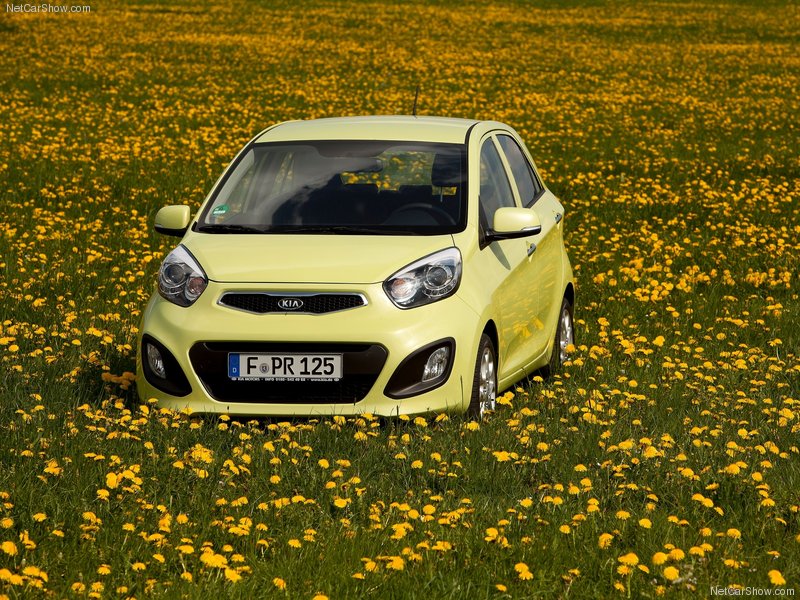
The all-new Kia Picanto, making its global premiere at the 2011 Geneva Motor Show, has been redesigned and re-engineered with stand-out styling to completely redefine its position as one of the most competitive vehicles in the global 'city car' A-segment.
With looks that convey a sense of solidity and maturity, new efficient engines and reduced CO2 emissions from 90 g/km, high levels of specification and safety features, the Kia Picanto will be offered for the first time with a choice of 5-door and 3-door body styles.
"Our new Kia Picanto is now a small car, grown-up," comments Soon-Nam Lee, Director of Overseas Marketing, Kia Motors Corporation. "It is such a complete car, such a high quality package, offering numerous premium features and multiple trim choices, that it will raise the fundamental perception of A-segment models to a higher level.
 "We anticipate that global demand for A-segment cars will be in the region of 2.4-million units annually over the next six years and we are confident that new Picanto will enable us to capture a larger share of this market," adds Mr Lee.
"The first generation Kia Picanto marked our debut in the A-segment in 2004 and went on to achieve more than 1.1 million sales globally over the following seven years, with sales in the UK totalling 77,810. I am sure that this new small Kia will become even more popular than the current vehicle," concludes Mr Lee.
UK consumers will benefit from the next generation Kia Picanto's greatly reduced CO2 emissions, improved fuel economy and reduced ownership costs when the model goes on sale in 2011.
 More space and more style
The Kia Picanto is the newest member to join the exciting and stylish Kia family. Kia has taken a courageous new step with the latest version of its smallest model. The character of the car has been transformed from 'cute' and 'feminine' into mature and handsome, designed to turn heads on the high street, thanks to its good looking, sexy proportions and dynamic design language. With a greater sense of stability and strength which is emphasised by the muscular wheel arches and wide set alloy wheels.
Up front, the face of the Kia Picanto expresses the same assertive vigour and refinement as its bigger brothers, the Venga and the Sportage, and shares with them the same signature 'tiger nose' grille. Kia Picanto's daylight running lights emphasis the high level of design and high tech sophistication.
 This bold front end is supported by a strongly-sculpted and dynamic body which embodies the strength and maturity of the Kia Picanto and gives the vehicle a real 'premium presence' on the road. The strong body feature line along the flank brings a dynamic tension to the car's profile and beautifully integrates the exterior door handles. This is just another example of the attention to detail which will set the new Picanto apart from its competitors.
Looking from the rear, the Kia Picanto's new design theme emphasises modernity, with its large rear window framed by the unique rear lamp graphic and supported by a strong purposeful bumper.
The 3-door model, with its unique treatment to C-pillar, bumpers and grille, offers an exciting exterior theme which will broaden the Kia Picanto's appeal to a wider audience when it goes on sale later in 2011.
 The graphic composition of the 3-door Kia Picanto's front face has been subtly moulded to increase the sporty characteristics of the vehicle. The expression is more aggressive, the message is livelier - this car is looking for action! Likewise from the rear, the contrasting bumper insert emphasizes the car's width and strength. It's all finely tuned to create a car with a distinctly different character to the 5-door model.
While becoming more stylish, the new 3.6-metre long Kia Picanto will also remain an extremely practical car. On the outside, overall vehicle length has increased by 60 mm, and the wheelbase has grown by 15 mm. These increases, and some clever interior packaging, have enhanced the cabin space for people (front legroom is up by 36 mm), and for luggage, with boot capacity increased by 27% to 200 litres.
Attention to small details of the exterior design have improved the new Kia Picanto's aerodynamics, reducing its drag figure to just Cd 0.31 - better than the vast majority of A-segment cars.
 Projection-style headlamps and LED rear lamps will be available, together with a choice of steel or alloy wheels up to 15 inches - bringing added sophistication to the exterior appearance.
Kia expects the new 3-door model to account for around 30% of Kia Picanto sales. The sportier-looking 3-door will be key in driving 'conquest' sales to new, younger consumer groups.
Raising the benchmark with 'big car' comforts
Manufactured exclusively at Kia's Seosan plant in Korea, Kia Picanto's new found maturity is also reflected in the interior design, which sets a new benchmark in its class for material quality and trim choices, new Kia Picanto will be presented in the UK with a wide range of six exterior colours.
New Picanto's sophisticated interior will offer buyers numerous 'big car' comfort and convenience features - many of them fitted for the first time on a car in this segment.
 The interior architecture shows the same chic functionality as the exterior with major controls arranged in an attractive and easy to use layout which emphasises the width and space of the interior. The thick rimmed two-spoke steering wheel and the signature Kia 'three cylinder' instrument cluster with its clear and precise graphics, reflect the consistency with which the new design philosophy is being used throughout the Kia product line-up.
New Kia Picanto will also be available with automatically controlled air-conditioning, electronic and heated folding door mirrors with side repeaters, automatic light control with 'escort' and 'welcome' modes, steering wheel mounted audio controls, retractable dual cup holders,
Other new features available include smart-key entry system with engine start/stop button, AUX, iPod and USB connections for the RDS radio CD player with MP3 compatibility, Bluetooth® hands-free with voice recognition, heated front seats and Intelligent Stop and Go that further enhances fuel economy.
 Highly efficient engines deliver great fuel economy
In Europe, every new Kia Picanto will come with a highly efficient Kappa engine that helps lower this model's CO2 base-line to just 95 g/km and improves fuel consumption to as much as 67.3 mpg.
Three versions of the Kappa will be offered - two in the UK. A four-cylinder, 1,248 cc engine that generates 85 ps and 121 Nm of torque tops the line-up. Two three-cylinder, 998 cc units will present customers with a choice of petrol or Bi-fuel technologies (LPG + petrol) - Bi-fuel is available in selected countries but not the UK. The petrol engine produces 69 ps and 95 Nm of torque. The Bi-fuel unit delivers 82 ps and 94 Nm of torque.
Made in Korea, the Kappa family of engines share many common characteristics, including dual CVVT (continuously variable valve timing), a cast aluminium block, off-set crankshaft, maintenance-free long-life timing chain and low-friction 'beehive' valve springs.
 This combination of advanced technologies means that exhaust emissions have been significantly reduced, so that the new, petrol only, Picanto line-up will have a CO2 rating of 99 to 125 g/km. Fuel economy will range from 67.3 to 42.2 mpg, contributing to lower running costs.
Selected models will also be available with Kia's fuel-stretching EcoDynamics technologies (automatic stop-start - ISG, advanced alternator control, upgraded starter motor and low-rolling resistance tyres), cutting emissions even further - to between 95 and 102 g/km.
The standard transmission for all engines in new Kia Picanto will be a 5-speed manual, while a 4-speed automatic gearbox will be available as an option on the 1.25-litre 85 ps engine.
Improved ride, stability and braking 
 New Kia Picanto's suspension and running gear has been developed from the previous model to retain that car's responsive handling while improving ride quality and refinement.
The MacPherson strut front suspension features an increased castor angle of 4.1 degrees, for enhanced straight-line driving stability, 12% softer springs and longer wheel travel with 20mm shorter bump-stops.
At the rear, the Coupled Torsion Beam Axle is 60% stiffer to reduce under-steer, with 29% softer springs, 15 mm shorter bump-stops and larger trailing-arm bushes for improved stability and a more compliant ride.
The Kia Picanto's all-disc braking system, which is standard on all models fitted with Electronic Stability Control, is backed up with standard ABS anti-lock, electronic brake force distribution and emergency 'brake assist' systems. Stopping distance from 100 kph (62 mph) is among the class-best at 41.0 metres.
 Enhanced safety for occupants and pedestrians
The all-new bodyshell created for the Kia Picanto uses a higher percentage of high-strength steel and incorporates ring-shaped reinforcing loops within the B- and C-pillars, plus additional bracing at the front between the cowl and suspension towers for improved rigidity.
For greater side-impact protection, the B-pillar and side sills are reinforced with high-tensile steel plates, the anti-intrusion door-beams are extended to overlap the B-pillar and polyurethane pads are fitted within the front door trims.
Available safety equipment will include up to six airbags, electronic stability control and hill-start assist.

For additional safety, an Emergency Stop Signal system is standard in Europe. Sensors detect when the driver is braking suddenly and hard, and then flash the brake lights three times to alert following drivers that the car is slowing rapidly.
Pedestrian safety has also been improved by fitting a new cross-member below the front bumper, creating a deformable cowling ahead of the windscreen and off-setting the hood striker by 50 mm from the car's centre line.
NVH counter-measures include larger hydraulic mountings for the engine and transmission, a triple-layer dashboard bulkhead sound-deadening panel, dual door sealing strips, and two measures to reduce wind noise - sound-blockers within the door mirror mounts and moving the radio antenna towards the rear of the roof.

Popular Posts