This is default featured slide 1 title

Go to Blogger edit html and find these sentences.Now replace these sentences with your own descriptions.

This is default featured slide 2 title

Go to Blogger edit html and find these sentences.Now replace these sentences with your own descriptions.

This is default featured slide 3 title

Go to Blogger edit html and find these sentences.Now replace these sentences with your own descriptions.

This is default featured slide 4 title

Go to Blogger edit html and find these sentences.Now replace these sentences with your own descriptions.

This is default featured slide 5 title

Go to Blogger edit html and find these sentences.Now replace these sentences with your own descriptions.

Showing posts with label Cadillac. Show all posts

Cadillac ATS 2013

Cadillac introduced the 2013 ATS, an all-new compact luxury sports sedan intended to challenge the world's best premium cars. Developed on an all-new, lightweight vehicle architecture, Cadillac's entry into the world's most significant luxury car segment goes on sale in summer 2012.
 The rear-drive ATS brings Cadillac's blend of technologically driven performance, elegance and design to a new audience of spirited drivers. Its sophisticated driving experience is enhanced with Cadillac CUE, a comprehensive, in-vehicle user experience that merges intuitive design with industry-first controls and commands for information and media data.
"Designed with quick, nimble and fun-to-drive dynamics, ATS expands Cadillac's portfolio into a crucial global segment," said Don Butler, vice president of marketing for Cadillac. "For a new group of luxury consumers, this is a car that will fit their lifestyle and challenge the segment's status quo."
The Cadillac ATS is a new expression of Cadillac's Art & Science execution philosophy, built on a foundation of driving dynamics and mass efficiency. It is the most agile and lightweight Cadillac, with one of the lowest curb weights in the segment - less than 3,400 pounds (1,542 kg).
Germany's famed Nürburgring served as one of the key testing grounds, along with additional roads, racetracks and laboratories around the globe, ATS engineers balanced performance with Cadillac's trademark refinement. Contributing components and features include:
  • Nearly 50/50 weight balance
  • Cadillac's first five-link independent rear suspension using lightweight, high-strength steel and efficient straight link designs
  • A multi-link double-pivot MacPherson-strut front suspension with direct-acting stabilizer bar
  • Driver-adjustable FE3 sport suspension with Magnetic Ride Control real-time damping
  • Underbody aerodynamic shields
  • Premium (belt driven) electric variable-effort steering gear from ZF Steering Systems
  • Four-channel ABS with available Brembo performance brakes
  • Available all-wheel drive
A spirit of lightness and balance
Making the Cadillac ATS one of the segment's lightest cars was a fundamental criterion for and the guiding principle during its development, but it was done in a nuanced manner that ensures a refined driving experience.
 "Low weight gives the Cadillac ATS a more nimble and controllable feel, while also optimizing the performance and efficiency of the powertrains," said David Masch, ATS chief engineer. "But we were careful to manage the weight while maintaining Cadillac's signature levels of refinement."
Optimizing the Cadillac ATS's mass was the result of a four-pronged philosophy that included strict adherence to original architectural goals, measured load management throughout the vehicle, benchmarking components to see if lighter solutions were available and an overall culture that "weighed" the mass of every component in the car against all aspects of its development.
An aluminum hood, magnesium engine mount brackets and even lightweight, natural-fiber door trim panels contribute to the Cadillac ATS's low overall mass - and reflect the systematic approach of evaluating every gram that went into the car. But some weight was deemed not only beneficial, but essential to the Cadillac ATS's driving experience. An example is the cast iron differential: Engineers found they could improve fuel economy with a cast iron differential rather than a lighter aluminum version.
And while the rear suspension is mostly steel, the focus on load management and straight links enabled significant weight savings without using alternate materials. This helps offset the weight of the engine and transmission at the front of the vehicle, helping the Cadillac ATS deliver its near-perfect 50/50 weight balance, while also contributing to lower noise and vibration. A similar approach was taken on the wheels, where extra structural aluminum was strategically added to further reduce vibration.
"We approached development by counting all the grams in the ATS," said Masch. "We minimized them where we could and put them to the best use where they were needed."
Tailored design weaves in signature style and refinement
The 2013 ATS interprets Cadillac's Art & Science design language in a new proportion, tailoring the signature styling and refinement cues for the most compact Cadillac while upholding - and advancing - the exemplary attention to detail and technological elements for which the brand is known.
 A long, 109.3-inch (2,775 mm) wheelbase and wide front/rear tracks are the cornerstones of the Cadillac ATS's firmly planted stance, which is enhanced by short overhangs and taut sheet metal that appears to wrap tightly around the tires. Seventeen-inch wheels are standard and 18-inch wheels are available.
Bold vertical lighting elements - including new LED front signature lighting detail - as well as illuminating door handles and active grille shutters lend technologically advanced style and function to the Cadillac ATS. The grille shutters close at certain highway speeds to reduce aerodynamic drag and enhance fuel economy.
A driver-focused interior with integrated technology and crafted materials complements the exterior elements and supports the ATS's driving experience. Everything from the placement of the pedals to the position of the shifter is designed for effortless and intuitive performance driving. Available performance seats have power-adjustable bolsters to optimize lateral support during high-load cornering.
Contributing to the interior's intuitive feel is an instrument panel that wraps into the doors and a center stack in the mid-instrument panel that flows into the center console. LED lighting for the bold gauge cluster enables clear, at-a-glance viewing in all lighting conditions, while ambient lighting accents functional elements of the console and doors.
 Real wood, plated metal plating and carbon fiber trim and Cadillac's cut-and-sew instrument panel, console and doors enhance the emotional connection to the Cadillac ATS. Choices of many interior color themes, each with unique accent trim material, cover a wide range of flavors - from light, open and warm to black and serious, to bold, technical and sporty.
CUE and ATS technologies
The ATS is offered with Cadillac CUE, a comprehensive, in-vehicle experience that merges intuitive design with auto industry-first controls and commands for information and entertainment data. It is designed to be unique for each consumer, from the "simple user" to the fully connected "super user."
CUE, which stands for Cadillac User Experience, pairs entertainment and information data from up to 10 Bluetooth-enabled mobile devices, USBs, SD cards and MP3 players with a vehicle infotainment system that reduces complexity through customized information, voice commands and fewer buttons and larger icons. For example, most of today's luxury cars have around 20 buttons controlling the radio and entertainment functions. CUE has only four.
The heart of CUE is the eight-inch LCD multi-touch sensitive screen, seamlessly integrated into the top of the central instrument panel and a motorized fully capacitive faceplate at the bottom concealing a 1.8L storage area. The vibrant LCD screen displays CUE's home page, which resembles a smart phone's screen by using large, easy-to-target icons to execute commands. Capacitive technology refers to using electrodes to sense the conductive properties of objects, such as a finger.
In addition to CUE, the ATS is offered with other technologies, including:
  • Bluetooth phone connectivity with voice recognition
  • USB, auxiliary and SD memory card ports
  • SiriusXM Satellite Radio with three-month trial subscription
  • Keyless access and keyless push-button start
  • Reconfigurable 5.7-inch instrument panel cluster display
  • Full-color reconfigurable heads-up display.
The Cadillac ATS is offered as a well-equipped standard model and in Luxury, Performance and Premium Collections. A Bose® Cabin Surround audio system is offered on the standard model, as well as Luxury and Performance Collections. It is standard with the Premium Collection. A navigation system is also available with Luxury and Performance Collections and standard with the Premium Collection.
'Control and alert' safety strategy
Safety in the ATS is based on Cadillac's "control and alert" strategy that employs advanced technologies - including radar, cameras and ultrasonic sensors - to help prevent crashes.
The safety features bolster driver vision and awareness of road hazards, and intervenes to help the driver avert potential crashes. In some cases, Cadillac's advanced crash-avoidance systems will act without the driver, such as automatic braking, which will activate based on information indicating potential hazards.
 Among the most sophisticated of the features is Front and Rear Automatic Brakes. This relies on short-range radar technology and ultrasonic sensors to help the driver prevent front and rear low-speed collisions via a progression of alerts that extend to complete braking, if necessary.
Optional advanced safety features include:
  • Full Speed Range Adaptive Cruise Control
  • Intelligent Brake Assist
  • Forward Collision Alert
  • Brake Pre-Fill Automatic Collision Preparation
  • Lane Departure Warning
  • Side Blind Zone Alert
  • Rear Vision Camera With Dynamic Guidelines
  • Adaptive Forward Lighting
  • Hill Hold/Start Assist (Standard, manual transmission)
The advanced technology safety features complement the Cadillac ATS's roster of other safety features, including eight standard air bags (10 with optional features), safety belt pretensioners and load limiters, StabiliTrak electronic stability control system with traction control and four-wheel disc brakes with four-channel ABS.
2013 Cadillac ATS also features OnStar standard for one year. It can use GPS and cellular phone technology to automatically call for help in the event of a crash. OnStar service also includes myCadillac and OnStar myLink mobile apps, which offer vehicle information, controls and OnStar services via the customer's iPhone or Android smart phone.
ATS Delivers New Levels of Control and Refinement
The 2013 Cadillac ATS delivers a driving experience that advances the brand's performance legacy with a balance of racetrack-honed control and uncompromising refinement.
 That experience is supported by new chassis and suspension systems, excellent power-to-weight ratios across ATS's power-dense powertrain lineup and a robust body structure that enables finer chassis tuning and greater crash protection. Highlights of the chassis and suspension features include:
  • Cadillac's first five-link independent rear suspension, using high-strength steel and efficient straight link designs
  • A multi-link, double-pivot MacPherson-strut front suspension with direct-acting stabilizer bar
  • Driver-adjustable FE3 sport suspension with Magnetic Ride Control real-time damping
  • Premium electric variable-effort steering gear by ZF Steering Systems
  • Four-channel ABS with available Brembo performance brakes
  • Available all-wheel drive.
Before selecting even the first fastener, engineers launched targeted research projects that helped determine the best design and optimal geometries for the front and rear suspensions. Early suspension prototype vehicles were constructed and tested in diverse environments, before complete Cadillac ATS prototypes hit the pavement at GM's global proving grounds, as well as highways and racetracks around the world.
"ATS engineers built on the legacy of the acclaimed CTS-V Series and picked up the challenge of well-established competitors to create an American sports sedan to rival Europe's finest," said Chris Berube, lead development engineer. "More than the roster of its chassis components, the Cadillac ATS's driving experience is derived from the whole of the car - a low curb weight, optimal balance and excellent dynamics refined during countless hours of racetrack testing."
 Proportion and balance are definitely on the ATS's side, with a low curb weight of less than 3,400 pounds (1,542 kg) and power-dense powertrains that are also lightweight to achieve a 50/50 weight distribution and a greater power-to-weight ratio. They complement wide front and rear tracks - 59.5-inch/1,512mm (front) and 60-inch/1,548mm (rear) - for a lower center of gravity that promotes greater stability.
The low curb weight also helped engineers optimize performance by not having to go big on components that contribute to unsprung weight, including the wheels, tires and brake components.
"A heavy car needs larger wheels and tires and larger brakes to account for its overall mass," said Berube. "With the ATS, its low weight meant we didn't have to spec the largest wheels and brakes in the segment - the performance is among the best in the segment with smaller, optimized parts that save weight and enhance efficiency."
Low vehicle mass and optimal brake sizes are expected to give the ATS's braking performance that is among the best in the segment, with Brembo brakes contributing to 60-0 performance of approximately 129 feet (39.3 meters).
A strong body structure is the backbone for the Cadillac ATS's driving experience. It ties the chassis and suspension elements together with great stiffness that enabled a higher degree of tuning precision.
"This is a rock-solid architecture that supports a rock-solid driving experience," said Berube. "But even the stiffest body can't ensure great ride and handling. That comes from an optimal suspension geometry and advanced damping control - and the ATS packs both."
Dual ball joints, five links and a limited-slip diff
Up front, a multi-link double-pivot suspension - based on the MacPherson strut design - is used for a more precise feeling of control, including more linear and communicative steering, and a smoother ride. It also improves impact isolation on bumps and rough surfaces.
The double-pivot system incorporates a pair of ball joints and lower control arms - one in tension and the other in compression - to replace a conventional wishbone at each wheel. The control arms, the spindle and the body form an effective four-bar link for each side of the front suspension, creating virtual pivot points for greater camber control. There is also a direct-acting stabilizer bar.
The front suspension's design also enables a longer spindle, larger pivot center and positive-offset steering geometry for optimal steering control, excellent straight-line stability and a more refined ride. High-durometer rubber and hydraulic bushings are used with the front suspension for an excellent balance of ride comfort and precise response when corning.
"The kinematics of the ATS's front suspension are more complicated, but the payoff is worth it in the way the car drives," said Berube. "The driver will feel directly connected to what the front wheels are doing, but with a comfortable degree of isolation that makes the Cadillac ATS a great touring car for long drives."
At the rear of the ATS is the first five-link independent suspension in a Cadillac. It's a design that helps reduces roll center motion, enables positive lateral control, reduces "squat" during acceleration and promotes excellent dynamic stability. In short, it helps keep the tires planted on all surfaces and during all hard-cornering maneuvers.
Four handling links (upper and lower control arms) are used at each side to control wheel motion and a toe link at each wheel provides additional horizontal control - particularly during hard cornering. The upper and lower links create an effective double-wishbone design, although the links are mounted independently.
As with the front suspension, the five-link design creates virtual pivot points that the ATS's engineers used for geometry optimization. The stiff links are mounted on a cradle that contributes to a smoother, quieter and more isolated ride. The cradle is made of steel (with hydroformed side rails) to help optimize the car's structural stiffness and mass.
"Using an aluminum cradle would have reduced the ATS's overall weight, but we found a few extra pounds at the rear suspension helped get the front/rear weight balance closer to the optimal 50-50 ratio," said David Masch, ATS chief engineer. "We also added mass to other areas of the car where it was necessary to achieve performance."
Seventeen-inch (17x8-inch) wheels used with 225/40-series tires are standard and 18x8-inch wheels and 255/35-series rubber are offered on the Cadillac ATS, with run-flat tires. Models with the FE3 suspension feature 18x9-inch rear wheels.
A mechanical limited-slip differential is a feature not matched by all other competitors and gives the ATS an edge when it comes to ensuring all of the powertrain's torque is applied to the tires during hard cornering. It is standard with the six-speed manual transmission and included with the FE3 sport suspension package. It is housed in a robust 8.6-inch carrier. Other models feature a 7.67-inch carrier.
MRC, electric power steering and other advanced control systems
Supporting the ATS's new suspension designs are advanced damping, steering and braking systems, including Magnetic Ride Control.
Magnetic Ride Control (MRC) is the heart of the FE3 Sport Suspension package, which is included on the Premium Collection and also includes a mechanical limited-slip differential, high-capacity cooling system and 18-inch summer-performance tires. MRC is a real-time damping system that delivers more precise body motion control. It "reads" the road every millisecond and can change damping in only five milliseconds.
With MRC, the conventional mechanical-valve shocks and struts are replaced with electronically controlled units filled with a magneto-rheological fluid, which contains minute iron particles. Under the presence of a magnetic charge, the iron particles align to provide damping resistance almost instantly. Sensor input determines the amount of resistance required, varying the magnetic charge to optimize damping.
Adjustable settings for the FE3 suspension allow the driver to select different ranges of damping for Magnetic Ride Control, including a competitive mode that also adjusts the intervention of the stability control and traction control systems.
All Cadillac ATS models come with a premium electric, variable-assist power steering gear from ZF Steering Systems. It is designed to deliver excellent response and on-center characteristics, while also saving fuel because engine power isn't directly required to assist gear movement - as is the case with conventional hydraulic systems.
The steering gear has great torsional stiffness and lower operating friction, which enhance the steering feel with almost perfect linear response. Additionally, the steering column and intermediate shaft feature stiff, direct-acting and low-friction ball bearing designs. That means there is almost no "lash" in the entire steering system, for a more immediate and connected-to-the-road feel for the driver.
Four-wheel disc brakes are standard on all models, with Brembo performance brakes available on the standard model and included on the Luxury, Performance and Premium collections. They are matched with a four-channel ABS system that is integrated with standard StabiliTrak stability control and full-function traction control.
All-wheel drive is available, for even greater traction assurance on wet and icy road surfaces.
2013 Cadillac ATS Priced from $33,990
The all-new, rear-wheel-drive Cadillac ATS compact luxury sport sedan, with a fuel-efficient 2.5L engine and next-generation six-speed transmission, is priced from $33,990, including destination charges. Highway fuel economy will be greater than 30 mpg.
"The ATS enters a vehicle segment this year that's one of the most competitive in the market, from both a price and performance standpoint," said Don Butler, vice president of Cadillac Marketing. "ATS will bring a distinctive presence and compelling value while offering quick, nimble, fun-to-drive dynamics that will appeal to the lifestyles of modern luxury buyers and challenge the segment's status quo."
A mid-level model, with a lightweight and powerful 2.0L turbocharged engine, costs $35,795 including destination and will offer automatic and manual transmissions, as well as rear- or all-wheel drive.
Topping the engine range is a 3.6L V-6 rated at 321 horsepower (239 kW), costing $42,090 including destination. It is equipped with an automatic transmission and standard content that includes CUE, leather eight-way power seats with memory, adaptive start and more. All-wheel drive is available.

Cadillac XTS 2013

Cadillac unveiled the 2013 XTS, the newest addition to the Cadillac luxury sedan lineup. It arrives in showrooms in U.S. and Canadian showrooms in the spring of 2012 as the most technologically advanced production car in the brand's history.
Larger than the CTS, the new Cadillac XTS delivers the space, elegance and dramatic presence that are Cadillac signatures, but with entirely new and technically advanced methods tuned for a new generation of luxury customers. It also marks the debut of CUE, a comprehensive in-vehicle experience that merges intuitive design with auto industry-first controls and commands for information and media control.

In addition to the CUE interface and connectivity, many other advanced technologies are integral to the new XTS. It will be the only luxury sedan with standard Magnetic Ride Control - the world's fastest-reacting suspension. Advanced technologies that enhance vision and safety surround the driver are available as well.
Positioned directly above the centerpiece CTS family in Cadillac's revamped lineup, the new XTS features a 3.6L direct injection engine and advanced all-wheel drive system, marking a shift to more-efficient performance in a spacious luxury sedan.
"The Cadillac XTS represents a new formula for luxury, driven by advanced technology," said Don Butler, vice president of Cadillac Marketing. "XTS showcases the evolution of our Art & Science philosophy, merging the best technical ideas with the continued refinement of Cadillac design."

Cadillac CUE is the highly customizable user interface that exemplifies XTS' blend of advanced technology and artistic design. The heart of CUE, which stands for Cadillac User Experience, is the standard eight-inch (203 mm) screen in the "center stack," the faceplate below the screen and the steering wheel controls. CUE features several industry firsts, including capacitive-touch control with proximity sensing, gesture recognition and natural voice recognition.

Available exclusively on the Cadillac XTS is the 12.3-inch (312 mm) reconfigurable cluster. It features vibrant graphic displays showcased among four driver-selectable themes, ranging from minimal to extensive information. And while it is the prominent element in the XTS' technological character, CUE is part of a more comprehensive and layered approach to the car's design, capabilities and performance
"The more you look, the more layers you see in XTS," said Butler. "They aren't always apparent to the eye, but they build on one another in important ways to reinforce the car's strength of design, comfort and driving experience."
Highlights include:
  • Advanced Haldex all-wheel-drive system with electronically 
  •  controlled limited-slip differential
  • Magnetic Ride Control, rear air suspension, HiPer Strut front suspension and Brembo brakes - all standard
  • Standard 19-inch wheels and available 20-inch wheels
  • Direct-injected 3.6L V-6 with lightweight features, including integrated cylinder heads/exhaust manifolds
  • Capless fuel tank filler for easier, cleaner refueling
  • Folding rear-seat headrests that enhance rear visibility
  • Safety Alert Seat that vibrates to alert the driver
  • Intervening braking system that lessens or avoids potential collisions
  • Short- and long-range radar systems that support:
  • Adaptive Cruise Control
  • Front and Rear Automatic Brakes
  • Rear Cross Traffic Alert.  
The XTS is also the most-spacious Cadillac sedan, tailored to provide roominess in a more efficiently sized package. It offers more interior space than midsize luxury cars and comparable to full-size sedans, particularly in the rear seat area, where it has 40 inches (1,016 mm) of rear legroom. That's about four more inches than the BMW 5-Series, and Mercedes-Benz E-Class and about two more inches than the Audi A6 - and comparable to larger sedans.
And when it comes to trunk space, the Cadillac XTS is in a league of its own, with 18 cubic feet (509 L), exceeding both midsize and full-size competitors - more than Audi A6 and A8 L, BMW 5 and 7-Series and Mercedes-Benz E- and S-Class. For XTS customers, the cargo advantage means room for five or more suitcases.

Technology reinforces multidimensional design philosophy
Cadillac XTS' hardware and spatial dimensions are the foundational layers that support a new level of surface detail. Multidimensional exterior and interior elements, including the grille, headlamps and new use of accent lighting, coalesce to give the XTS a presence and attention to detail unlike any Cadillac that has come before it.
"The XTS' technology is woven into its design in ways that affirm the driving experience is of primary importance to a new generation of luxury customers," said Clay Dean, design director and Cadillac brand champion. "This is the new expression of luxury at Cadillac and it shows in the multilayered details, authentic materials and unprecedented connectivity."
CUE, for example, represents the pinnacle of technology, but it is being showcased using a subtle and sophisticated interior appearance that blends with other features to create a soothing and inviting feel. It offers more capability and driver-selectable choices than ever before from Cadillac, but the center stack has only seven buttons - three of them for the radio. That's less than half the controls found on the center stack of the typical car.

"Technology helps the XTS deliver more with less," said Dean. "Choreographed interior lighting and other unique features tailored to individual driver preferences complement CUE to create an exceptionally refined and advanced ambience."
The Cadillac XTS' surface details also convey a more-nuanced design philosophy, with elements that support the long, sleek proportion that is a welcome return to Cadillac. They bring forward more beauty and elegance with refined, graceful forms and surfaces working harmoniously with established Cadillac linear forms. It is a car that conveys the next step in Cadillac form and surface vocabulary.
"It is a bold, elegant design and also very efficient in the ways it encompasses passengers and cargo," said Dean. "It's a new proportion for Cadillac and a new era in luxury."
The Cadillac XTS Platinum is the fullest expression of Cadillac's multidimensional philosophy, with features that include a chrome/satin-chrome grille finish, polished 20-inch aluminum wheels with chrome inserts, a fully wrapped leather interior with Alcantara headliner and more.

Advanced safety features based on 'control and alert' strategy
The Cadillac XTS' technology fundamentally supports a suite of advanced safety features, based on a "control and alert" strategy that extends the vision around the vehicle. It helps drivers identify potential crash situations and even intervenes when a crash threat appears more imminent, employing layers of visual, audible and tactile (vibration) alerts, depending on the alert feature.
The alerts are designed to identify obstacles with sufficient warning to give the driver time to react and make changes - including the Safety Alert Seat feature, which vibrates either the left or right side of the driver's seat cushion, depending on the location of the impending concern. The intervening features, including Automatic Collision Preparation, take over if the threat appears more immediate or the driver does not react to previous alerts.
Two levels of control-and-alert protection are offered in the Cadillac XTS' Enhanced Safety Strategy (ESS) packages.
ESS I includes:
  • Lane Departure Warning
  • Forward Collision Alert
  • Safety Alert Seat
  • Side Blind Zone Alert
  • Rear Cross Traffic Alert
  • Reflected LED display.
ESS II includes all ESS I content plus:
  • Head-up display (in color)
  • Front and Rear Automatic Brake
  • Adaptive Cruise Control
  • Automatic Collision Preparation
Cadillac XTS also features OnStar as standard. OnStar service also includes myCadillac and OnStar myLink mobile apps, whichoffer vehicle information and OnStar services via the customer's 
smartphone.

AWD and Magnetic Ride Control support new driving experience
A layered approach to the driving experience relies on new and established technologies - all rooted in a stiff structure. The body is infused with strategically placed ultra-high-strength steel for strength and crash protection and serves as the foundation for the advanced-chassis system.
A smart Haldex all-wheel-drive system - with an electronic limited-slip differential that splits torque between the rear wheels - complements an advanced HiPer Strut front suspension and standard Magnetic Ride Control real-time damping to give the Cadillac XTS sure-footed, confident and comfortable ride and handling traits. A linked H-arm design with "air springs" comprises the rear suspension.
HiPer Strut is based on the MacPherson strut front suspension design and features dual-path top mountings that separate the transfer of spring and damper loads to the body structure. It improves ride-and-handling characteristics in four significant ways:
  • Provides more linear and communicative steering through improved camber control
  • Improves impact isolation on bumps and rough surfaces
  • Reduces torque steer
  • Improves vehicle sensitivity to tire irregularities and wheel imbalance.
Magnetic Ride Control delivers precise body motion control - "reading" the road every millisecond and changing damping in just five milliseconds. It replaces conventional mechanical-valve shocks with electronically controlled shocks filled with a magneto-rheological fluid containing minute iron particles. Under the presence of magnetic charge, the iron particles align to provide damping resistance almost instantly.
StabiliTrak electronic stability control is standard on all models, along with variable-effort steering and Brembo four-wheel disc brakes with four-channel antilock brakes - all features that add important layers of control to the driving experience. Like Magnetic Ride Control, Cadillac XTS borrows the Brembo braking technology from Cadillac's V-Series of high performance models.
Horsepower for the Cadillac XTS comes from an advanced 3.6L V-6 that's known by its "LFX" engine code. It is rated at an estimated 300 horsepower (224 kW). Lightweight features help reduce overall weight for greater efficiency and a more favorable front-to-rear weight balance. Examples include a composite intake manifold saves approximately 5.5 pounds (2.5 kg) over the weight of a comparable aluminum intake and an integrated cylinder head/exhaust manifold design that saves approximately 13 pounds (6 kg) per engine.
The LFX engine is matched with the Hydra-Matic 6T70 six-speed automatic transmission with tap-shift control.
The Cadillac XTS will begin production in Oshawa, Ontario in spring 2012.

Cadillac SRX 2012

Cadillac SRX retail sales rose 17.7 percent in the first half of 2011, building on a record-setting 2010 sales increase of 150 percent.
The new 3.6L - known by its "LFX" engine code - is the sole engine offered in the Cadillac SRX. It delivers 16-percent more horsepower (308 hp / 230 kW) than the previous V-6 and provides greater low-rpm torque. Vehicle responsiveness is dramatically improved in all operating conditions - launch from a standstill, around town maneuvering in traffic, passing maneuvers and full-throttle acceleration. It is matched with the Hydra-Matic 6T70 six-speed automatic transmission, which features a driver-selectable Eco feature that alters the shift points and throttle progression to help optimize fuel economy.
Cadillac SRX also brings enhanced features for 2012, as well as updates that make it quieter and more refined - including new sound-absorbing material placed strategically throughout the vehicle. The Base and Sport suspension systems have been revised to improve the ride quality.
"The improvements we've made to the 2012 SRX make an already great luxury crossover even better, giving our customers more performance and features," said Don Butler, vice president of Cadillac Marketing. "Many of the changes are a direct response to consumer feedback, demonstrating Cadillac's commitment to total customer satisfaction."
Feature and content enhancements for 2012 include:
  • Standard Bluetooth phone connectivity on all models, with on-screen caller identification
  • OnStar Turn-by-Turn automated directions are loaded to the vehicle
  • Improved voice recognition for phone activation, navigation and radio station changes
  • A heated steering wheel on the Luxury, Performance and Premium Collections
  • Door lock switches on the driver and passenger door panels as well as the center console
  • Cruise control buttons on the steering wheel
  • Memory seat set - the occupant can set the seating position simply by pressing "set" and the number simultaneously
  • Backlighting for map lights in the overhead console
  • A new machined-face finish on the 20-inch wheels, which are standard on Performance and Premium Collections
  • Available all-ebony interior trim
  • One new exterior color: Xenon Blue Metallic.
Popular features returning for 2012 include a moveable cargo fence and large under-floor storage space in the rear, a liftgate that can be programmed to stop at different heights and the UltraView sunroof that covers 70 percent of the vehicle roof.
The new and enhanced elements that contribute to a quieter ride include new acoustic material in the upper instrument panel, front-of-dash area, the center console area and the inner fenders, as well as laminated glass used in the front side glass. There is also a new laminated structural barrier used under the second-row seat to block noise.
Click to review the complete list of the 2012 SRX's standard and available features.
Inside the LFX
The Cadillac SRX's new LFX 3.6L direct-injected V-6 delivers an SAE-certified 308 horsepower (230 kW) and 265 lb.-ft. of torque (359 Nm), with efficiency-enhancing features including direct injection and continuously variable valve timing. Peak torque is achieved at only 2,400 rpm and is maintained through 5,300 rpm. The LFX is also E85 ethanol-capable.
"The development team was challenged to achieve 300 horsepower in the SRX and exceeded the target," said Liz Pilibosian, chief engineer. "The horsepower and low-end torque of the 3.6L deliver greater power on demand at launch, on steep grades and when passing. The power band of the LFX engine also contributes to a better shift feel."
The LFX engine is a technically advanced 60-degree V-6 with dual-overhead camshafts, continuously variable valve timing and direct injection. Supporting elements that contribute to its performance, refinement and durability include:
  • The cylinder block and cylinder heads are cast in aluminum for low weight.
  • A composite intake manifold saves approximately 5.5 pounds (2.5 kg) over the weight of a comparable aluminum intake. It also has a comparatively small radiated surface area to help it maintain excellent noise and vibration characteristics.
  • An integrated cylinder head/exhaust manifold design saves approximately 13 pounds (6 kg) per engine when compared with a comparable engine with separate head/manifold assemblies.
  • The cylinder heads include four valves per cylinder, with a dual overhead camshaft design incorporating infinitely variable cam phasing.
  • A forged steel crankshaft provides optimal strength in the bottom end, while the connecting rods are made of powdered metal that features a higher ratio of copper, which makes them stronger and enables them to be lighter.
  • The pistons are made of lightweight cast aluminum and feature a friction-reducing polymer coating on the skirts , as well as fully floating wrist pins, which also help reduce friction. Less weight in the pistons means less reciprocating mass in the engine, which in turn means less inertia and greater operating efficiency.
  • Pressure-actuated oil squirters drench the underside of each piston and the surrounding cylinder wall with an extra layer of cooling, friction-reducing oil.
  • A cast aluminum oil pan is stiffer to improve powertrain rigidity and reduce vehicle vibration. It bolts to the transmission bell housing as well as the engine block, eliminating points of vibration. Cast aluminum dampens internal engine noise better than a conventional stamped steel pan and is structurally stiffer.
  • Optimized-flow fuel injectors and the integrated exhaust manifolds/cylinder heads promote lower emissions.
To help achieve their performance goals, the Cadillac SRX's engineers redesigned the exhaust system with dual runners from the engine to a collection point farther rearward in the vehicle. The diameter and length of the pipes were specifically tuned to improve low-end torque from 1,200 to 3,000 rpm.
High-pressure exhaust pulses from each of the cylinders in the engine are timed to arrive at this collection point so that they phase together in a precise way. This tuning effect, which is called scavenging, literally pulls exhaust gases out of the engine by synchronizing high and low pressure pulses from each cylinder. Peak torque now occurs at a very low 2,400 rpm and remains high all the way through 5,300 rpm. The torque and power improvements were achieved while maintaining quiet performance.
"No stone was left unturned when it came to optimizing the airflow of the LFX, from the moment it enters the engine until it is expelled through the muffler," said Pilibosian. "The exceptional airflow qualities enabled us to exceed the 300-horsepower target, while careful calibration of the dual continuously variable valve timing system and the exhaust system contribute to the engine's great low-end torque."
The LFX engine is paired with the Hydra-Matic 6T70 electronically controlled six-speed automatic transmission, with tap up/tap down driver control. A wide overall ratio spread of 6.04:1 allows a "steep" first gear, as well as a "tall" overdrive top gear for low-rpm highway cruising. Acceleration is maximized, as is fuel economy. Engine noise is also lower during cruising. Because of the wide ratio spread (6.04:1), first gear is a very high ratio, which provides brisk acceleration from a stop. Sixth, however, is an overdrive ratio, which keeps the engine revolutions as low as possible for highway cruising, reducing engine friction losses and improving fuel economy.
A driver-selectable Eco feature alters the shift points of the 6T70 to enhance fuel economy by up to 1 mpg. A clutch was added to the variable displacement air conditioning compressor to enhance fuel economy. The compressor is only run when needed and provides no drag when turned off.
Chassis and suspension
The Cadillac SRX has a four-wheel independent suspension system and a standard rack-and-pinion hydraulic steering system - and offers a variable-effort, speed-sensitive steering system - with tuning biased for sport sedan-style driving and strong on-center feel. StabiliTrak electronic stability control is standard and works with the standard four-wheel-disc/four-channel-ABS braking system.
The core elements of the chassis and suspension systems include:
  • An independent MacPherson strut suspension system is standard on all models, featuring a direct-acting stabilizer bar and hydraulic ride bushings.
  • An independent "H-arm" rear suspension incorporates a lightweight hollow aluminum lower control arm and a hollow stabilizer bar.
  • Power-assisted rack-and-pinion steering is standard on Base and the Luxury Collections.
  • Power-assisted variable-effort and speed-sensitive rack-and-pinion steering system is standard on the Performance and Premium Collections.
  • A rear axle ratio of 3.39 is standard on all models.
  • A trailering package is available on the Luxury, Performance and Premium Collections and increases the towing capacity to 3,500 pounds (1,587 kg).
For 2012, the Base suspension offers greater ride quality that maintains excellent handling characteristics, thanks to new upper front strut mounts, improved shock valve tuning, new bonded bushings for the front stabilizer bar and new twin-tube rear shocks that provide greater road isolation.
The Sport active suspension - standard on Performance and Premium Collections - is also improved for 2012, with new front upper strut mounts, new shock valving, bonded stabilizer bar bushings and revised calibrations for this continuously variable real-time damping suspension system. Electronically controlled dampers at each corner "read" the road constantly to make real-time adjustments within milliseconds. They deliver the just-right damper rate for all road conditions, for greater comfort and a greater feeling of control. This system also increases damping during aggressive handling maneuvers to reduce the roll velocity and pitch velocity of the vehicle for a more confident feel.
Cadillac SRX is also offered with an all-wheel-drive system that incorporates an electronic limited-slip (eLSD) rear differential. It not only improves traction in slippery road conditions, but it provides side-to-side torque transfer along the rear axle to enhance control during hard cornering. It was developed in partnership with Haldex, a leader in all-wheel-drive technology and the eLSD enables the AWD system to distribute torque from the front to rear axle, and also side-to-side, across the rear axle, sending power to the wheel with the greatest traction.

Cadillac Ciel Concept 2011

The Cadillac Ciel Concept - pronounced "C-L," the French translation for sky - is a four-seat convertible that opens a new chapter in Cadillac's design and product ascent, pushing the brand's Art & Science philosophy into a new stratum. Ciel is a new expression of Cadillac's historical grandeur, as well as a celebration of open-air motoring.
"Large, expressive luxury is innate to Cadillac and the Ciel recalls that heritage, while suggesting where the brand can go in the future," said Clay Dean, global design director for Cadillac. "Authentic luxury is driven by experiences, not just products, and Ciel is about the experience of the journey."
The spacious and elegant Cadillac Ciel Concept is a grand gesture that explores themes driving Cadillac's explorations into range-topping flagship luxury. It is powered by a twin-turbocharged version of the 3.6-liter Direct Injection V-6 engine, paired with a hybrid system using lithium-ion battery technology.
Coastal inspiration
Driving California's Highway 1 in an open car while the sun sets, from Big Sur north to Monterey, is the type of journey the Ciel team envisioned during its design.
"The Ciel is about the romance of the drive," said Dean. "It emulates the great touring cars seen on the greens at Pebble Beach, but with a modern flair that projects Cadillac's vision for the future."
The four-door Cadillac Ciel Concept embraces the social aspects of a recreational journey, with generous room for two couples. It evokes the spirit of the classics with a long, low proportion. The doors are French-style, with the rear doors hinged at the rear - there is no B-pillar - to reveal a sweeping view of the dramatic interior. Distinguishing fender lines run from nose to tail, and nickel-plated bright work accents the body lines, enhancing the visual length of the car and honoring Cadillac touring cars of the past.
Cadillac Ciel Concept's exterior flows seamlessly into the cabin, with the body color rolling over on top of the interior door panels. Like the exterior, the passenger space is accented with sweeping nickel-plated trim. It divides the body-color upper sections from a complementing beige lower color. Italian Olive wood, machined aluminum and hand-tipped leather are elements that flow through the interior, complementing the primary colors with warm, rich tones.
"There is authentic craftsmanship in the way the exterior and interior elements meld, much like a vintage wooden boat," said Gael Buzyn, interior design manager. "It is romantic, not only in its form, but the materials - nothing smells as good as real wood and leather. It blends together for a rewarding feeling of uncompromising luxury."
Cadillac Ciel Concept literally and figuratively reflects the driving experience along the California coastline. The Cabernet paint color, developed specifically for Ciel, is inspired by the rich translucence of a glass of red wine held up to the sunlight.
A prominent, polished aluminum windshield frame serves as in important structural element of the vehicle, as well as aesthetic one, recalling classic open cars of the past. Additional exterior cues, including a shield grille and vertical lighting elements, are pure Cadillac, but suggest a more organic interpretation of the brand's signature design language that emphasizes the artistic and natural sides of it. The body sides, for example, are more rounded, sweeping upward. Bright work is used to bring contrast to the deep paint color, but plays a more supporting role.
The car rides on large, beautifully finished wheels that feature brushed nickel plating over milled billet aluminum, matching the materials and appearance of other trim. Carbon ceramic brake rotors are visible behind the 22-inch rims, a visual clue to the Ciel's foundation of performance.
And owing to Cadillac's heritage of advanced technology, the headlamps and taillamps feature LED lighting elements - including a unique daytime running light graphic on the front of the vehicle that is generated with gradated LED lighting.
Elegant, authentic details
Simplicity, authenticity and spaciousness were the guiding principles when it came to developing the Cadillac Ciel Concept's interior.
"With the Ciel, the journey is the thing, so the interior is a place of uncompromising comfort and elegance, with technology that only makes the journey more enjoyable," said Buzyn. "Simplicity and lightness ensure nothing distracts from the open driving experience, while the color and materials lend the feeling that the vehicle's environment blends with the surroundings."
A wheelbase of 125 inches - about 12 inches longer than a CTS sedan - provides generous space. Luxurious seats are bisected by a "floating" center console that runs from the instrument panel to the rear of the interior. It effectively creates a very personal space for each passenger and houses access to hidden connectivity portals for each person in the vehicle - allowing them to make dinner reservations, check the weather at their destination or even upload photos of the trip via social media sights.
Simplicity is also the watchword with the Cadillac Ciel Concept's instrument panel, which features a minimalist gauge cluster that doesn't impede or distract from the outward view. But while reserved in its form, it exemplifies Cadillac's attention to details and its priority on authentic materials. The climate vents, for example, are mostly hidden and their airflow is distributed indirectly.
Transparent gauges deliver their information within a detailed, brushed-aluminum housing that has the intricate depth of a high-quality chronograph. They offer dual readouts - analog and digital - as well as an information hierarchy. Additional interior features include:
  • Sloping bolsters on the seats that allow passengers to slide into the seats more comfortably
  • A personal device storage area on the front of the console with inductive charging and Bluetooth connectivity
  • A power-assisted transmission shifter that deploys as soon as the engine is started
  • Lighting in the armrests that combines a natural light well for daytime driving and ambient lighting for nighttime drives
  • Door storage areas that are inspired by premium fashion accessories and open with high-quality zippers
  • Pull-out blankets are available for all three passengers and retract automatically
  • All the seats have heating and cooling features, along with a drawer containing sun lotion, sun glasses and towels, as well as aromatherapy that is controlled from the rear armrest.
But perhaps the defining element of the Ciel's cabin is the incorporation of Italian Olive wood on the doors, instrument panel, console and the front seatbacks, adding warmth and craftsmanship to a car designed to provoke an emotional response.
"Milled solid wood delivers richness and a sensual feeling of authenticity in the visual impact of the grain, its feel and aroma, which a veneer simply cannot," said Buzyn. "Even in our high-tech, connected world, luxury customers crave touches of old-world craftsmanship - the Cadillac Ciel Concept simply reflects that with a blend of the latest technology."
Italian Olive wood is a premium yet sustainable material and the material used in the Ciel came from a single fallen and recycled tree, from a west coast producer of premium olive oil. It was painstakingly prepared, including drying in a kiln, before it was cut for the concept vehicle. The numerous pieces were then photographed so that the grain could be matched precisely. Each component was hand-milled and finished by expert woodworking craftsmen.
The rear seating area is detailed with elegant flourishes. The rear seat passengers can pull a leather tab, which reveals a cashmere blanket that stretches across the seating area to ward off a chill. The wood trim in the rear center console opens to reveal a small humidor, stocked with a few cigars.
"From the materials used to create it to the space and experience it offers passengers, the Cadillac Ciel Concept represents a unique perspective on luxury, but not the only one," said Dean. "Along with other concepts, such as the ULC, Cadillac is demonstrating that the bandwidth of the Art & Science philosophy is wide, indeed - and we're going to make it even wider."
The Cadillac Ciel Concept was developed at GM Design's North Hollywood Design Center, which is managed by Frank Saucedo. Niki Smart was the lead exterior designer, with Buzyn leading interior development.

Cadillac CTS Coupe 2011

Cadillac CTS Coupe is the new focal point of Cadillac, expressing both our design and technical capabilities," said Bryan Nesbitt, Cadillac general manager. "It is intended to appeal to a new generation of car enthusiasts."
The Coupe joins the Cadillac CTS Sport Sedan, the 556-horsepower (415 kW) CTS-V and new CTS Sport Wagon as the foundation of Cadillac's lineup. A high-performance V-Series edition of the Coupe will also be released in 2010.
The Cadillac CTS Coupe's design carries over virtually unchanged from the concept car that was introduced at the North American International Auto Show in Detroit in 2008.
The Coupe is a classic 2+2 layout bolstered with advanced technology, such as a rear-view camera system and a performance-oriented suspension system coupled to rear-wheel or all-wheel drive.
Cadillac CTS Coupe emerged as a proposal inside Cadillac's design studio, where designers have developed and evolved the brand's Art and Science design philosophy.
"Cadillac has always been an emotional brand - it's about delivering art regardless of body style," said Max Wolff, director of exterior design for Cadillac. "With the Cadillac CTS Coupe, it was about taking something very strong - the CTS Sport Sedan - and extending its potential."
The coupe has the same wheelbase as the CTS, but an overall height that is approximately two inches (51 mm) lower and an overall length that is two inches (51 mm) shorter.
Although it draws from its sport sedan sister, the Cadillac CTS Coupe shares only the instrument panel, console, headlamps, front fenders and grille. Key design features include:
  • Classic hardtop styling, with no conventional B-pillar
  • Touch-pad operation for the doors removes the need for conventional door handles, creating a technical, clean profile
  • A windshield laid at a faster angle (62.3 degrees) and a long, nearly horizontal backglass area combine to create a sleek, aerodynamic look
  • Sculpted lower front fascia with unique brake-cooling vents
  • Diamond cut-style rear fascia with mesh lower grilles
  • Center-outlet exhaust with twin dihedral-shaped tips that pass through the rear fascia
  • Signature vertical lighting, highlighted with LED light pipes
  • Rear spoiler integrated into the center high-mounted stop lamp
  • Sculpted roof-mounted antenna for OnStar and XM Satellite Radio
At first glance, the shape of Cadillac CTS Coupe is refreshingly simple, yet amplified with intricately carved details. Distinctive and original Cadillac signature cues combine with hand-sculpted forms, artfully articulating the confidence of the chassis. For example, the rear fenders were purposefully developed by hand in Cadillac design studios to visually acknowledge the RWD powertrain. The gestured profile, coupled with Cadillac's vertical taillamps and pronounced rear centerline, aim to achieve the most visually confident coupe in the segment.
Performance
The Cadillac CTS Coupe extends Cadillac's emerging performance credentials. The Cadillac CTS Coupe's standard powertrain consists of a direct injected 3.6L V-6 and six-speed manual transmission. Direct injection technology delivers fuel more precisely to increase the efficiency of combustion, enabling more power while maintaining fuel economy and lowering emissions - including a 25-percent drop in cold-start hydrocarbon emissions.
The 3.6L DI engine is rated at 304 horsepower (227 kW) and offers EPA-estimated fuel economy of 27 mpg on the highway. It also runs on less expensive regular unleaded gasoline.
The powertrain's performance is channeled through a chassis that delivers sports car performance without punishment. The hardware includes an independent short/long arm ( SLA) front suspension system, with hydraulic control arm front bushings; and a multi-link rear suspension mounted on a fully isolated subframe. Also included are four-wheel disc performance brakes, premium steering and limited-slip differential.
Two suspension-tuning levels are available: a Performance Package with 18-inch wheels and all-season tires (available in both RWD and AWD,) and the Summer Tire Performance Package, with 19-inch tires and wheels and a higher level of road holding capability. StabiliTrak, the advanced electronic chassis control system, is standard.
The 304-horsepower (227 kW) 3.6L V-6 Direct Injection engine will be standard, equipped with a six-speed manual, featuring a revised clutch and dual-mass flywheel that offers better clutch pedal feel and improved engine isolation. A 6-speed automatic transmission with Driver Shift Control (and available steering wheel mounted shift buttons) is optional.
Technology
Cadillac CTS Coupe blends handcrafted luxury with a contemporary, driver-focused interior that supports the car's high-performance capabilities. The interior includes hand-sewn accents covering the door, center storage console and instrument panel trim. 14-Way adjustable Recaro sport seats, previously exclusively offered on Cadillac V-Series model, will be offered on all Cadillac CTS Coupe models as an option.
The car offers a host of advanced technologies, including:
  • Integrated iPod/MP3 capability
  • 40-gig hard drive, including the ability to store music and pause-and-replay live radio
  • Pop-up navigation system
  • Adaptive forward lighting system
  • Blue-tooth connectivity
  • Standard Key-less Access and Smart Remote Start
  • Rear Camera system
  • Bose 5.1 Cabin Surround™ audio system
As with other Cadillac models, the Cadillac CTS Coupe comes standard with OnStar with Turn-by-Turn Navigation, the first factory-installed, fully integrated GPS navigation system from OnStar.

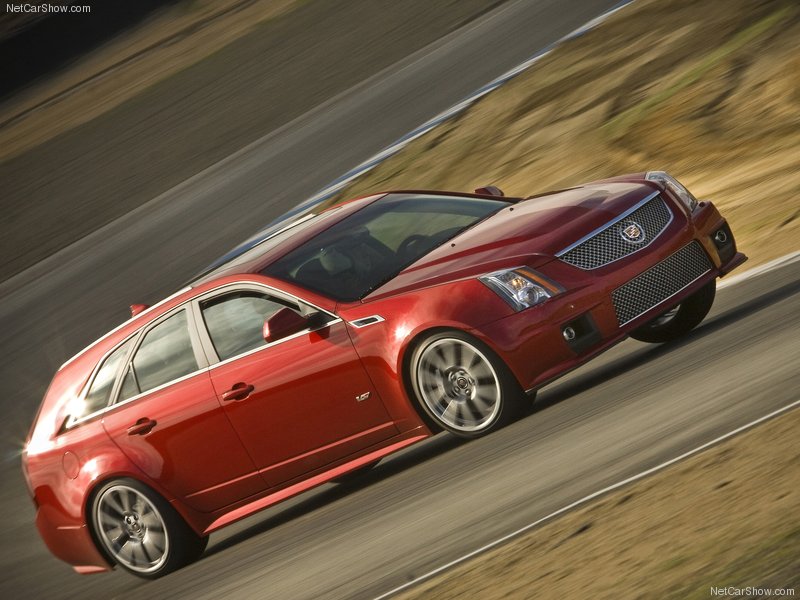
Cadillac CTS-V Sport Wagon 2011

The Cadillac CTS-V Sport Wagon is a natural extension of both the V-Series and the CTS lineup, offering an uncompromising performance car to enthusiasts who want the extra room of a wagon," said Don Butler, vice president for Cadillac marketing. "The V-Series Sport Wagon is another hallmark of the dramatic presence and power of Cadillac vehicles."
The exterior is finished in Midnight Silver, first seen on the Cadillac Sixteen Concept, and accented by lustrous Liquid Silver-finished wheels and a black chrome finish on the grille's mesh insert. The rear fascia, upper spoiler and center high-mounted stop lamp are also unique to the show car.
Inside, the Cadillac CTS-V Sport Wagon show car is trimmed in exclusive black leather with Alcantara accents. The upper section of the instrument panel and upper door panels are covered in the same premium leather, accented with midnight Sapele wood, while the microfiber material and stitching is applied to the lower door panels, pillars, console lid, headliner and steering wheel center. The show car features fine-grain black leather-trimmed Recaro seats with Alcantara seat inserts. The seat inserts are divided in the center and accented with dark gray stitching, while the V-series logo is laser etched into the seatbacks. Obsidian Black accents grace the center stack, console, steering wheel and door panels.
The show car's bespoke color and trim elements hint at the potential direction of color and trim in future Cadillac models. These elements are not yet intended for production, but represent Cadillac's desire to gauge customer reaction to new color and trim options.
Production Cadillac CTS-V Sport Wagon
The Cadillac CTS-V Sport Wagon will go into production in late 2010, with initial sales in North America, followed by export markets including Europe and the Middle East. The new model rounds out the V-Series offerings, which include all variants of the CTS family's sedan, coupe and sport wagon body styles.
Like its sedan and coupe stable mates, the Cadillac CTS-V Sport Wagon is powered by a supercharged 6.2L V-8, which delivers 556 horsepower (415 kW) and is backed by either a six-speed manual transmission or a six-speed automatic. A suite of technical and performance elements complement the powertrain, including Magnetic Ride Control, Brembo brakes and Michelin Pilot Sport PS2 performance tires mounted on 19-inch forged aluminum wheels.
Like the other CTS V-Series models, the Sport Wagon incorporates a unique grille that doubles front-end airflow to help enable its high-performance capabilities. It is also visually identified by an aggressive front fascia and raised center section of the aluminum hood that provides clearance for the supercharger. It rides on 19-inch forged aluminum wheels available in painted or polished finishes.
The rest of the exterior carries the dramatic design of the new CTS Sport Wagon; the details of which include:
  • Signature V-shaped deck and tailgate motif
  • Large, vertical taillamps with light-pipe technology
  • Power-opening liftgate (via key fob or in-vehicle button)
  • CHMSL-integrated roof spoiler
  • Integrated roof load management system with available cross bars for a seamless appearance
  • Cargo management system with adjustable in-floor containment
  • Available panoramic UltraView sunroof
At the rear is a pair of 3-inch (76 mm) chrome exhaust outlets, which caps a performance dual-exhaust system made of high-grade stainless steel that will maintain a lustrous appearance longer than ordinary stainless.
Of course, cargo capability is a hallmark of wagons and the V-Series Sport Wagon delivers with 25.4 cubic feet (720 liters) of space behind the rear seats and 58 cubic feet (1,644 liters) with the seats folded - virtually doubling the available space of the sedan.
Supercharged performance
The 6.2L supercharged V-8 engine powers the Cadillac CTS-V Sport Wagon - the same acclaimed engine found in the V-Series Sedan and Coupe models. Rated at 556 horsepower (415 kW) and 551 lb.-ft. of torque (747 Nm), it is the most powerful engine offered in Cadillac's history.
The engine features an intercooled Eaton Twin Vortices Series™ (TVS™) supercharger. This unique supercharger design employs twin four-lobe rotors, twisted 160 degrees. Typical superchargers feature three lobes twisted 60 degrees. The fourth lobe and added twist, when combined with unique air inlet and outlet ports, create smoother, more efficient airflow into the engine. In addition to improved overall efficiency, this supercharger has superior noise and vibration characteristics compared to more ordinary designs.
A pair of six-speed transmissions is offered in the Cadillac CTS-V Sport Wagon - a Tremec TR6060 six-speed manual with a dual-disc clutch and a Hydra-Matic 6L90 six-speed automatic with steering wheel-mounted shift controls. The steering wheel-mounted controls require no shift lever movement and allow immediate tap up/tap down gear selection. Performance Algorithm Shifting provides the automotive transmission with a performance-oriented shift pattern during sustained high-performance driving. As with many Cadillac models, the driver needs only to slide the shifter into the manual "gate" to put the transmission into a performance mode.
Torque is channeled through the six-speed transmissions to a high-performance rear axle that features a limited-slip rear differential within a cast iron housing for greater thermal management and asymmetrical half-shafts to smoothly manage the supercharged engine's incredible torque. The unique design includes alternately sized half-shafts that also help dynamically balance the oscillation of torque from side to side, effectively eliminating "power hop."
Magnetic Ride Control
The V-Series achieves exceptional levels of road-holding performance, but also maintains the poise of a luxury car in "regular" driving conditions. The technical enabler of this dual-mode driving character is Cadillac's landmark Magnetic Ride Control. It is standard on the Cadillac CTS-V Sport Wagon and is the world's fastest-reacting suspension technology. It uses shocks controlled by advanced magneto-rheological technology, rather than mechanical valves, to greatly accelerate response time and precision.
Electronic sensors at all four wheels literally "read the road" every millisecond, making constant adjustments to damping to create virtually instantaneous and extremely precise control of body motions. This is of particular benefit for a high-performance car because it helps keep the car very composed during hard cornering, acceleration, braking and other dynamic maneuvers.
The Magnetic Ride shocks also enable a broader range of damping control to optimize the ride and handling for all driving conditions. In the Cadillac CTS-V Sport Wagon, an extra measure of control is offered, with two selectable modes (Tour and Sport), enabling the driver to tailor the suspension for grand touring or more spirited performance driving.
Cadillac pioneered Magnetic Ride Control, bringing it to production first in 2002, following decades of research on magneto-rheological science. Today, the technology appears only on a short roster of the world's most elite vehicles, including Cadillac V-Series models, the Escalade luxury SUV and the STS and DTS luxury sedans.
Brembo brakes and Michelin Pilot Sport PS2 tires
The Cadillac CTS-V Sport Wagon incorporates sophisticated braking and tire systems, in partnership with two companies renowned for high-performance technology: Brembo and Michelin. Brembo brakes are at all four corners and include powerful, six-piston calipers in the front and four-piston calipers in the rear.
Large vented rotors enable strong initial braking force while optimizing heat resistance and eliminating fade. The brake rotors from Brembo are manufactured with "dual-cast" technology that combines cast iron and aluminum, resulting in superior performance and weight reduction.
The Cadillac CTS-V Sport Wagon also includes an electric parking brake, which allows for optimal dead pedal placement, which is important for high-performance driving.
Michelin partnered with Cadillac engineers to develop an exclusive Pilot Sport PS2 tire specifically engineered for the CTS-V. The tires support high levels of grip in track conditions, while also affording excellent performance on the road.
Comfort, style and technology
The interior of the Cadillac CTS-V Sport Wagon is shared with the sedan, including streamlined instrumentation, LED lighting and hand-cut-and-sewn accents.
The Cadillac CTS-V Sport Wagon production model will come standard with performance seats featuring perforated sueded microfiber inserts designed to hold the driver and front passenger in place during cornering. Recaro performance driving seats are optional and provide excellent support for spirited driving. These 14-way adjustable performance seats include pneumatic bolster controls in the seat cushions and backrests.
Complementing the performance seating are a thick steering wheel and a gauge package designed for easy, at-a-glance reference during performance driving. Large instruments have bold readouts, including an LED-lit "tracer" function in the tachometer that flashes as the engine nears the red line. The gauge layout includes a boost gauge and a lateral acceleration display.
Obsidian Black accents grace the center stack, console, steering wheel and door panels. The production steering wheel and shifter are available in Alcantara, providing the luxurious character of suede. These accents are elegant to the touch and aid the driver during support high-performance driving. Just like every CTS, the V-Series includes a hand-stitched instrument panel, door trim and center console.
Leading-edge infotainment features extend to the V-Series. Standard features include an advanced navigation system with a deployable screen, Bose 5.1 digital surround audio, factory-installed Bluetooth phone integration and a 40-gigabyte hard drive that allows the customer to store a large library of music files. The system uploads files via a USB port or the in-dash DVD/CD drive and allows stored tracks to be searched and selected through the radio controls.

Popular Posts